
Happy Monday!
The Strait of Hormuz is, at this point, the investing world's version of Schrödinger's cat. It's both open and closed at the same time, depending on what hour you check.
This also means the Iran war is far from over, and so is short-term volatility.
That said, let's zoom in on the bigger themes: the S&P 500's latest rally to an all-time high was led by only 12 stocks, one valuation indicator is flashing the loudest warning in decades, energy is the year's best-performing sector by a mile, and Tesla reports earnings on Wednesday alongside 93 others. We cover all these in the deep dive.
Before that, here is a quick recap of the weekend's key developments:
On Friday, Iran declared the strait after a ceasefire announcement between the US and Lebanon. This led to euphoria in stocks: the S&P 500 jumped 1.2% to close at 7,126.06, a record all-time high. The Nasdaq posted its 13th consecutive winning day, its longest streak since 1992. The Dow surged 868 points while oil crashed 12%.
But then things changed on Saturday as Iran fired on commercial vessels in the Strait. On Sunday, the US Navy fired on and seized an Iranian-flagged cargo ship in the Gulf of Oman.
By Sunday evening, Tehran said the strait was closed again until the US lifts its naval blockade. Subsequently, peace talks scheduled for Monday in Pakistan were called off as Iran pulled out of the second round of peace talks. Brent jumped nearly 6% in early trading.
Monday futures opened lower - Dow down 358 points, S&P 500 off 0.58%.
The Deep Dive
We cover four stories in this week's deep dive:
- The S&P 500 is at record highs with just 2.4% participation
- This one indicator is flashing caution
- Energy is the real winner of 2026
- Tesla and 93 others report this week
Let's take a closer look…
1. The narrowest rally in decades
By March 30, the S&P 500 had nearly entered the correction zone when it was down 9.1% from its January high. In the next 11 trading sessions, the index set a new all-time high.
The Magnificent Seven, which make up around 36% of the index market cap, soared 8.5% for the week. The Nasdaq posted its best weekly gain since late 2024.
So far, that's great for investors recovering from war-induced anxiety, except that when the S&P 500 hit its record close on Wednesday, only 12 stocks in the entire index were trading at 52-week highs. That is just 2.4% of the index.
This, however, picked up through the week - 19 stocks by Thursday and 52 by Friday, indicating that the rally is getting somewhat broader.
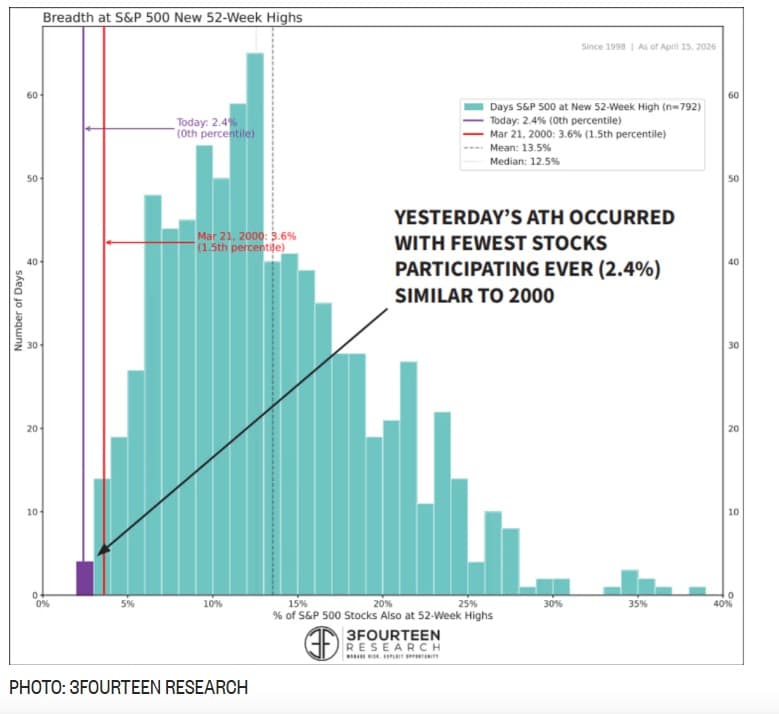
Image: 3Fourteen Research
Warren Pies of 3Fourteen Research noted that the only other time the S&P 500 rallied 10% in 10 days and ended at or near all-time highs was March 2000 - the peak of the dot-com bubble. That rally was also led by only a handful of stocks.
2. One indicator is flashing caution
While the headline indices are at record highs, one valuation metric is sitting at an uncomfortably high level: The Shiller CAPE ratio.
The ratio measures price against average inflation-adjusted earnings over the past ten years. It currently sits at 36. That is the second-highest reading in history, about 18% below its all-time record of 44.
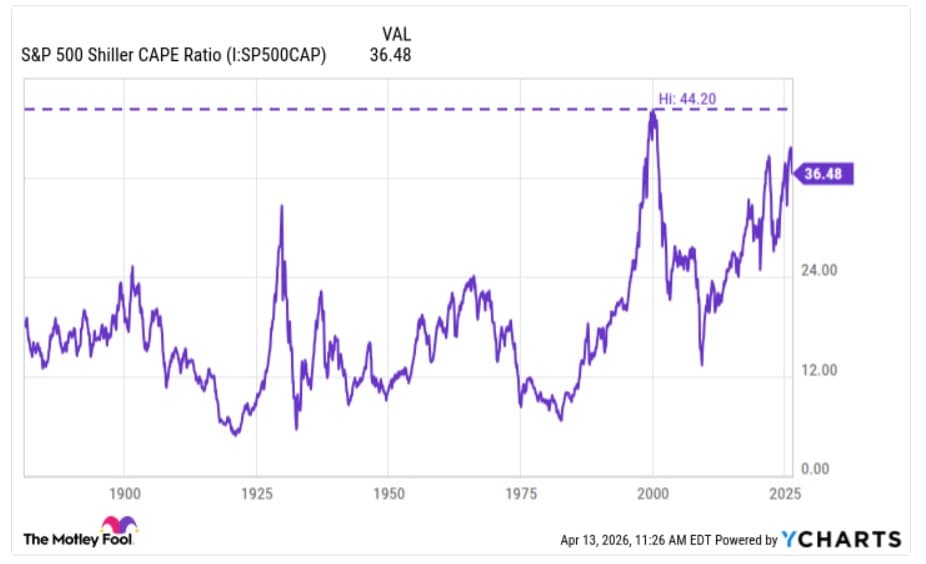
Image: The Motley Fool
There have been two crucial instances when the CAPE has reached such extremes: the late 1920s before the Great Depression, and the year 2000 before the dot-com crash.
But note that the CAPE is not a tool for timing the market. It only tells that the market is pricing in a lot of optimism relative to a long run of earnings history.
3. Energy still leads in YTD gains, but will the momentum last?
The broader market spent the first quarter dealing with war headlines and correction fears. One sector, however, simply went on to make money: energy.
According to data from Yahoo Finance, the sector is up nearly 22% year-to-date, making it the best-performing sector in the S&P 500 by a wide margin.
For context, Technology, the index's largest sector at over 30% of market weight, is up just 4.61%. Industrials and Basic Materials are the next closest, at 16% and 19% respectively, both benefiting from the same physical-assets rotation.
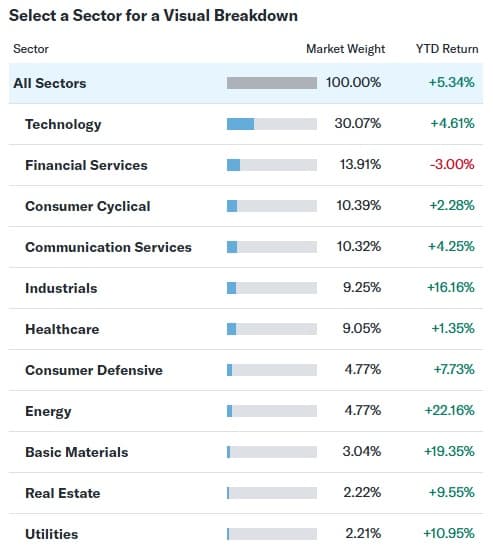
Image: Yahoo Finance
The driver, of course, is oil as Brent crude went from $73 a barrel before the war to above $109 at its peak - a move of more than 50% in six weeks. Companies that produce, refine, and ship oil do not need a complicated thesis when the price of their product surges that dramatically.
The more interesting question now is what happens if normalcy returns in the Middle East. A lasting resolution would lower energy margins. So, investors sitting on those returns will need to decide whether the energy trade is still on a solid footing.
4. Earnings season heats up - Tesla goes first
This week is the third busiest of the season, with 94 S&P 500 companies scheduled to report. The headliner is Tesla on Wednesday - the first of the Magnificent Seven to go.
All seven Mag stocks remain below their 52-week highs despite last week's surge, which means earnings calls are going to be significant.
Beyond Tesla, Boeing, American Express, ServiceNow, and 3M are also reporting this week. Analysts are calling for full-year 2026 earnings growth of 18%, with Q2 through Q4 projected at 20.1%, 22.2% and 19.9%, respectively.
These are optimistic numbers in any environment, let alone in one where oil traded above $100 for most of March, and the world's most important shipping lane remains closed.
Before we sign-off
Markets move not just on data, but on how investors interpret them. In each of the stories we cover, it all comes down to market expectations and sentiment. When sentiment runs ahead of fundamentals, what follows is volatility.
At AlphaPro, we track the voice behind the numbers and tone of earnings calls, policy speeches, and analyst commentary. Our Earnings Sentiment Score helps you cut through the noise and see how executives and policymakers are shaping narratives in real time.
Same time next week?
See you then.
Want to explore real-time sentiment scores, earnings call insights, and curated stock research?