
Happy Monday!
Since we sent out our last issue, a new war has broken out in the Middle East, engulfing as many as 12 countries and counting. And whenever something happens in that region, the first thing markets do is hurt the global economy at its weakest point: oil supply.
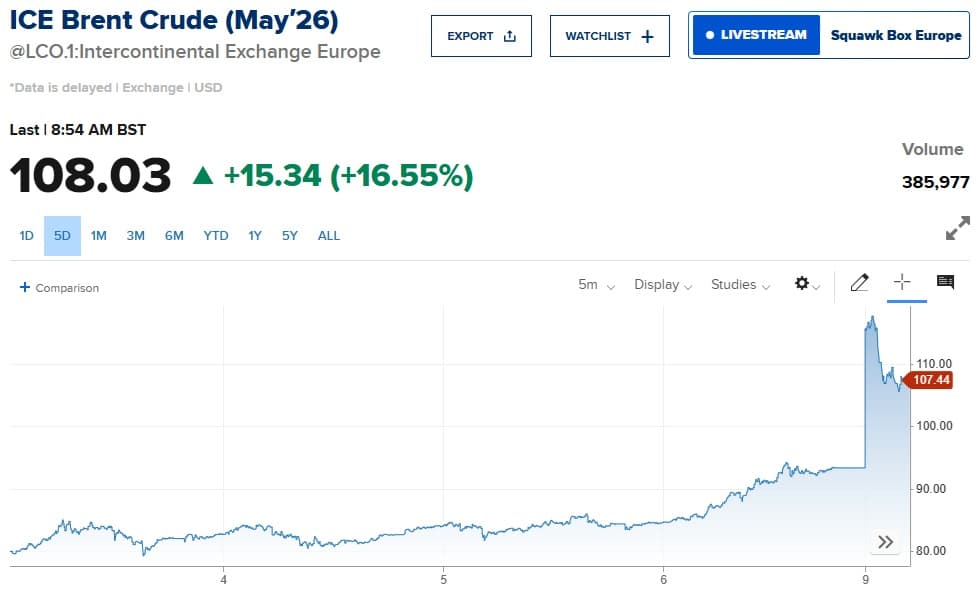
U.S. crude soared 35.63% last week, making it the biggest weekly gain in the history of the futures contract, going all the way back to 1983. Brent is up 28% for the week, marking its highest weekly gain since the spring of 2020
On Friday, West Texas Intermediate (WTI) rose over 12% to close at $90.90 per barrel. Brent settled at $92.69, rallying 8.52%. But Monday's Asian session brought another shock: WTI surged over 31% intraday, hitting a high of $119.43 before pulling back to trade around $108. Brent tracked closely, surging past $108.
How much further can oil move, how quickly, and what does this mean for the global economy? We get into all of it in the deep dive.
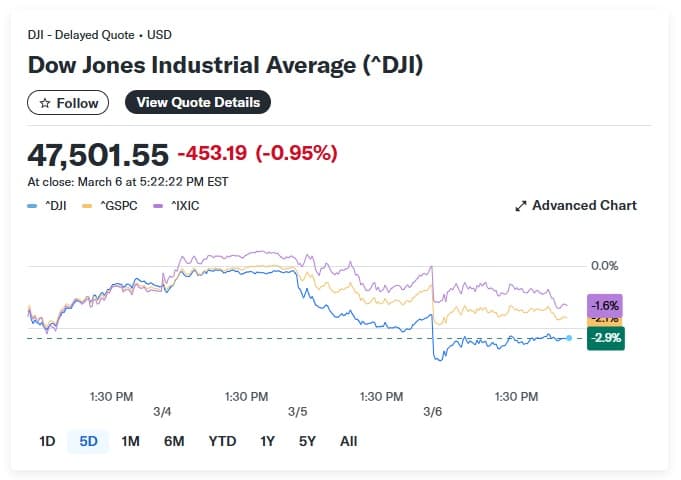
Equities, meanwhile, are getting battered. For the week, the S&P 500 shed 2%, the Dow fell 3%, and the Nasdaq lost 1.2%. All three indices are now negative for the year:
The VIX, the market's panic thermometer, surged 24% on Friday alone. It now sits 97.26% higher year-to-date, closing the week at 29.49 - just shy of the 30 level that signals extreme market fear and investor anxiety.
The disappointing job data - nonfarm payrolls unexpectedly falling by 92,000, and the unemployment rate inching up to 4.4% in February from 4.3% in January - couldn't have come at a worse time.
That said, four stocks need your special attention: in the latest S&P 500 reshuffle, Vertiv, Lumentum, Coherent, and EchoStar joined the index. Every index fund and ETF tracking the S&P 500 has no choice but to buy them. But the stocks shown the door face exactly the opposite.
The Deep Dive
This week, we focus on four stories shaping market sentiment:
- Oil at $150 in weeks? Crude just posted its biggest weekly gain since futures began trading in 1983
- S&P 500 gets four new entrants: what it means for Vertiv, Lumentum, Coherent, and EchoStar
- Materials post their worst week in nearly a year
- Boeing soars on a 500-jet China deal in the middle of a brutal week for markets.
Let's take a closer look…
1. Oil at $150 in weeks?
Oil's near-term direction depends on the fate of the Iran war. It has already brought traffic through the Strait of Hormuz, one of the world's most critical energy corridors, to a near standstill.
If peace is restored quickly, or if the conflict spirals out of hand, it may push the global energy market into sustained chaos. Qatar's energy minister, Saad al-Kaabi, warned the Financial Times that crude could hit $150 per barrel within weeks if the Strait remains out of bounds for oil tankers.
He added that most Gulf exporters would likely declare force majeure on shipments within days, and those who don't face serious legal liability down the road.
On the supply side, Iraq has already cut 1.5 million barrels per day of output, according to two Iraqi officials cited by Reuters. Kuwait has begun trimming production after running out of storage space.
The disruption could Kaabi said.
2. S&P 500's four new entrants
S&P Dow Jones Indices confirmed that optical-networking companies Lumentum and Coherent, along with Vertiv, a data-center infrastructure play, and satellite TV and wireless company EchoStar, will join the S&P 500 in its latest rebalancing.
Vertiv shares jumped nearly 6% in extended trading on the news. EchoStar rose about 4%. Lumentum and Coherent added 1.7% and 0.4%, respectively.
The moves follow a familiar pattern: stocks added to the S&P 500 typically see an upward momentum as index-tracking funds buy in to mirror the benchmark.
On the flip side, stocks removed from the index tend to face selling pressure as those same funds unwind their positions. Match Group, Molina Healthcare, Lamb Weston, and Paycom are being shown the door.
3. Materials post worst week in nearly a year
The S&P 500 materials sector is on pace for its worst weekly performance since early April last year, down roughly 8% for the week
PPG Industries and Freeport-McMoRan are each down more than 12% for the week. CRH and Amcor have both fallen around 11%, while Vulcan Materials is off close to 10%.
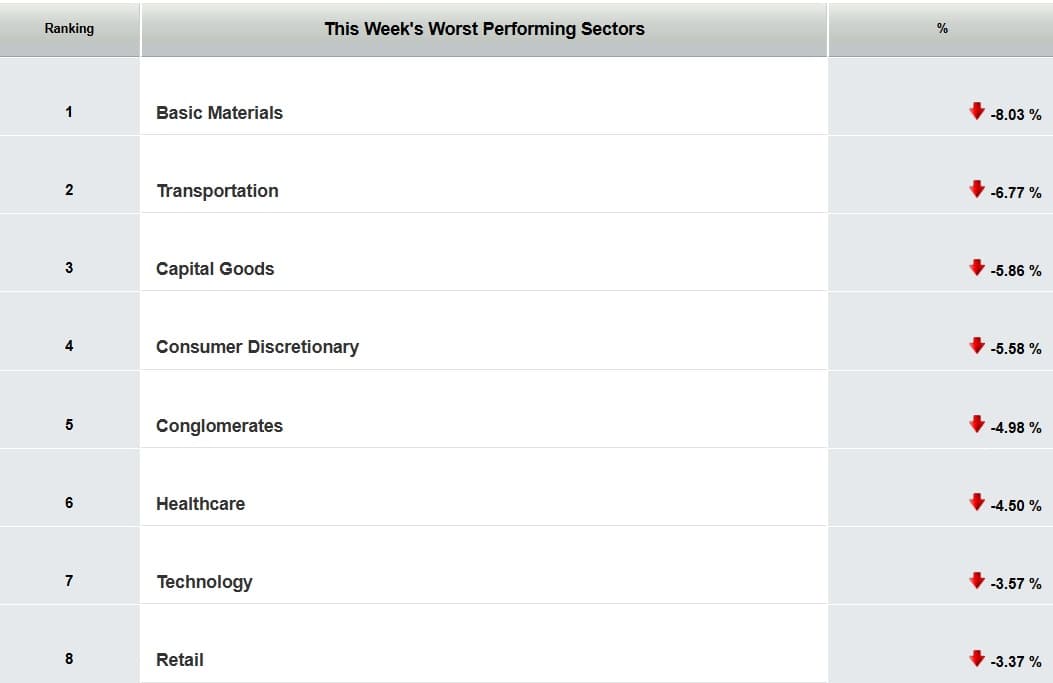
The sector was already under pressure from slowing global demand and lingering trade uncertainty. War-driven supply disruptions are creating further headwinds.
Materials companies are deeply exposed to international supply chains, commodity input costs, and industrial demand. All of which are now in serious question. Surging oil drives up input costs for industrial manufacturers and materials producers across the board, squeezing margins.
Until there's clarity on how long the conflict disrupts trade routes and logistics, expect the sector to stay in the crosshairs.
4. Boeing soars on a 500-jet China deal in the middle of a brutal week for markets
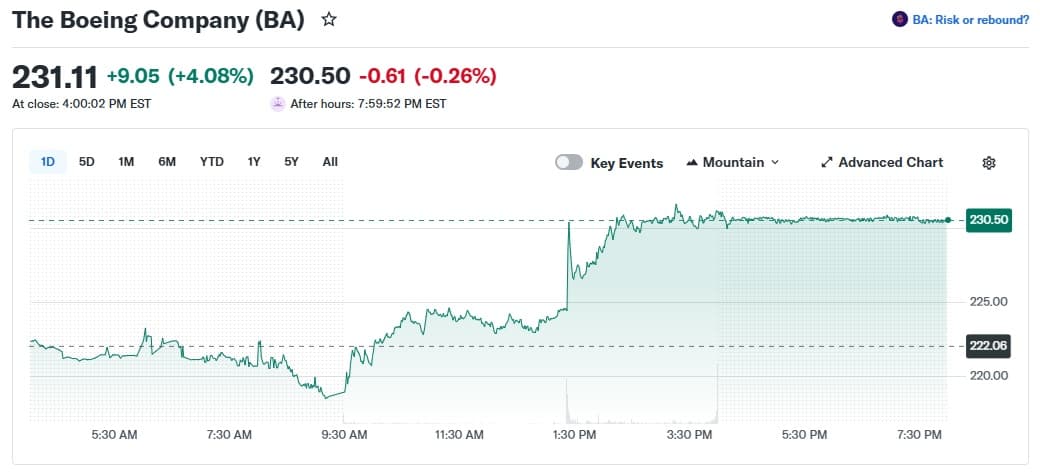
While most of the market was in freefall, Boeing had a very different kind of Friday: it closed at $231.11, up over 4.08%, after reports emerged that China is nearing a record order for 500 737 Max jets. It's one of the largest single commercial aviation deals in history.
Boeing led the Dow on the day.
The deal is being shaped around President Trump's upcoming visit to Beijing, scheduled for March 31 to April 2, where trade and aviation are expected to dominate the agenda.
Chinese carriers are actively looking to expand and modernize their fleets, and Boeing has found itself with real negotiating leverage.
Before we sign-off
Markets move not just on data, but on how investors interpret them. In each of the stories we cover, it all comes down to market expectations and sentiment. When sentiment runs ahead of fundamentals, what follows is volatility.
At AlphaPro, we track the voice behind the numbers and tone of earnings calls, policy speeches, and analyst commentary. Our Earnings Sentiment Score helps you cut through the noise and see how executives and policymakers are shaping narratives in real time.
Same time next week? See you then.
Want to explore real-time sentiment scores, earnings call insights, and curated stock research?