
Happy Monday!
The market's fate is now tied to the direction of the war, and the latest price moves show that investors expect a prolonged conflict, longer than what most were anticipating just last week
The market has good reasons to panic, given that the end of the war is nowhere in sight. That said, JPMorgan has cut its S&P 500 year-end forecast while Goldman has raised its oil price outlook. And the IEA chief has warned of the worst energy crisis in decades.
We get into all of it in the deep dive section.
On Saturday, President Trump gave a 48-hour ultimatum to Iran to reopen the Strait of Hormuz, through which 20% of the world's oil supply moves, threatening to
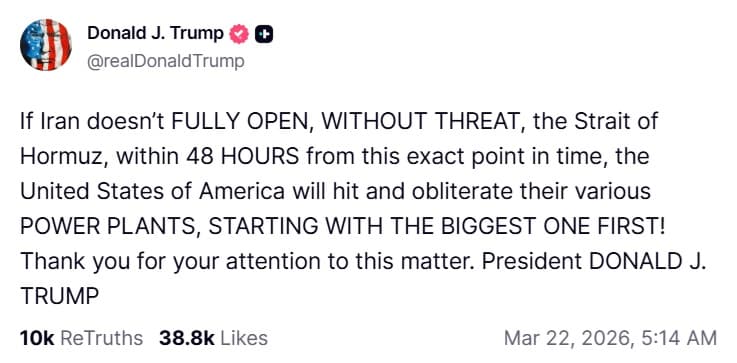
Iran is in no mood to back down, however.
A defiant Tehran said it would escalate strikes on energy infrastructure and target critical water desalination facilities if Trump follows through.
Meanwhile, Israel has officially announced an expansion of its ground campaign in Lebanon, following a series of strategic strikes on key infrastructure.
The S&P 500 is down 5% so far this month and just finished its fourth straight losing week. The Nasdaq is approaching correction territory, a pullback of 10% or more from recent highs.
Energy stocks, meanwhile, are defying gravity in an otherwise panicked market.
The Deep Dive
This week, we focus on four stories shaping market sentiment:
- The world could face the worst oil shock in decades: IEA chief
- What do past oil shocks tell us about the market?
- JPMorgan cuts S&P 500 forecast
- These energy stocks are defying gravity
Let's take a closer look…
1. The world could face the worst oil shock in decades: IEA chief
The IEA's executive director, Fatih Birol, warned that world leaders have not fully grasped the consequences of the Strait of Hormuz closure. The disruption has already removed 11 million barrels of oil per day and roughly 140 billion cubic metres of gas from global markets.
To put that in context: the twin oil shocks of 1973 and 1979 together removed about 10 million barrels per day - 5 million each. Russia's invasion of Ukraine pulled roughly 75 billion cubic metres of gas off international markets. The current crisis, which began with strikes against Tehran on February 28, has already surpassed both combined.
Birol said this crisis is equivalent to the combined force of the 1970s oil shocks and the Russia-Ukraine fallout. The disruption, he warned, could
Adding to the concern, Goldman Sachs raised its oil price forecast for 2026, calling this the largest-ever supply shock for global crude markets. Brent is now expected to average $85 a barrel this year, up from Goldman's earlier forecast of $77.
2. What do past oil shocks tell us about the market?
This isn't the first time oil has spiked so dramatically.
Since 1973, there have been seven such episodes where crude surged 40% or more: the Arab oil embargo, the Iranian Revolution, Iraq's invasion of Kuwait, OPEC cuts in 1999-2000, the commodity surge ahead of the 2008 financial crisis, the Arab Spring in 2010-11, and the post-COVID reopening of 2020-22.
In almost every one of those episodes, the S&P 500 fell into or approached the bear market territory.
The 1973-74 crash saw stocks lose more than 40%, with the oil embargo cited as a major cause. In 1990, the index pulled back roughly 20% as oil spiked after Iraq invaded Kuwait. In 2022, rising oil was a key driver of the inflation crisis that pushed equities into bear territory.
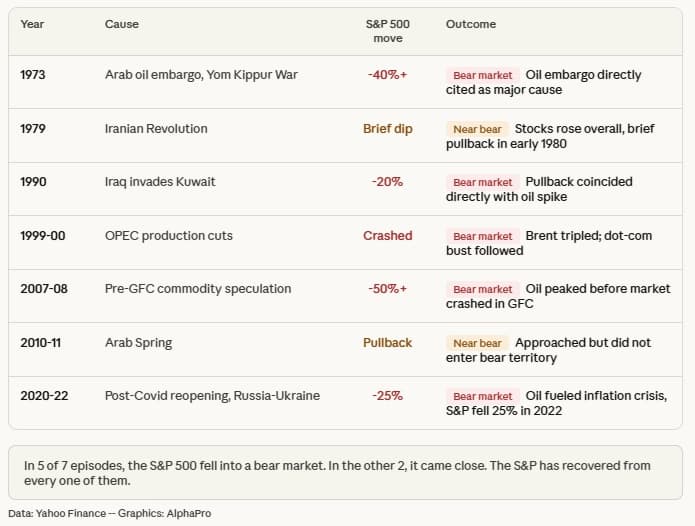
That said, a brief oil spike on its own rarely causes a recession. But if the disruption continues for weeks, on top of an already-weakening market, it is a much more serious situation.
3. JPMorgan Chase cuts S&P forecasts
JPMorgan strategists led by Fabio Bassi cut their year-end S&P 500 target to 7,200 from 7,500, citing the Strait of Hormuz supply shock and its expected drag on corporate profits and economic growth.
Higher energy prices for longer, the bank wrote in a note to clients, will pull global growth lower and push inflation higher. JPMorgan, however, recommends staying invested but keeping downside hedges in place.
The near-term risk, according to the firm, is more about multiple compression rather than a deep earnings recession, as investors reassess economic growth and liquidity. Oil sustained around $110 through year-end would trim S&P 500 earnings by 2-5%, with further pressure if crude keeps climbing.
But despite the dampened outlook, note that JPMorgan's revised target still means there is a potentially 11% gain from Friday's close to year-end.
4. These energy stocks are defying gravity.
While the broader market sells off, energy is having a very different kind of year.
Year-to-date, Exxon Mobil (XOM) is up 32.68%, Chevron (CVX) has gained 32.36%, and ConocoPhillips (COP) leads the integrated majors at 35.58%.
Cheniere Energy (LNG) is the standout at 44.50% YTD. It's a direct beneficiary of surging demand for liquefied natural gas as Europe and Asia look to replace Middle East supply.
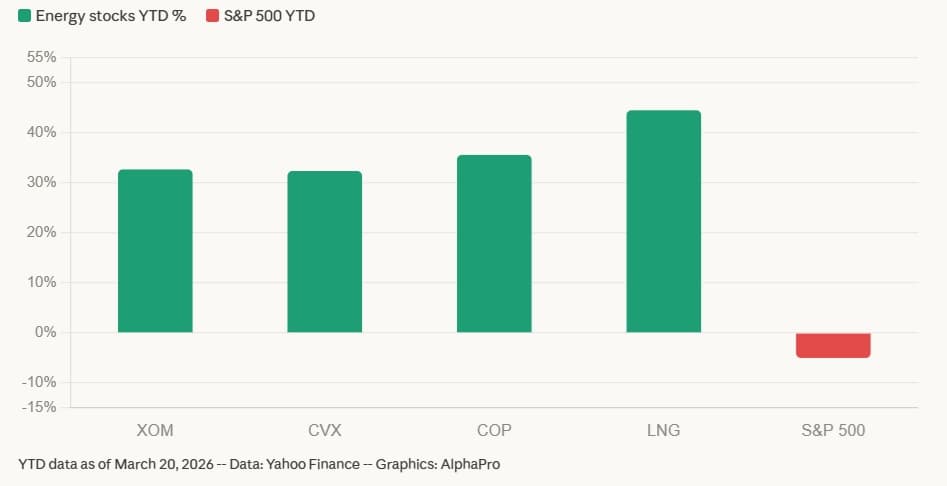
When there's a sharp rise in oil and gas prices, the companies that produce, refine, and ship them tend to see strong earnings growth.
With Goldman forecasting higher oil prices and Qatar's energy minister warning of Brent at $150, the tailwind for this group of stocks remains strong.
Before we sign-off
Markets move not just on data, but on how investors interpret them. In each of the stories we cover, it all comes down to market expectations and sentiment. When sentiment runs ahead of fundamentals, what follows is volatility.
At AlphaPro, we track the voice behind the numbers and tone of earnings calls, policy speeches, and analyst commentary. Our Earnings Sentiment Score helps you cut through the noise and see how executives and policymakers are shaping narratives in real time.
Same time next week? See you then.
Want to explore real-time sentiment scores, earnings call insights, and curated stock research?