
Happy Monday!
The war-torn market has a predictable trading pattern: optimism from Monday to Wednesday and then nervousness starting on Thursday. As Bloomberg calls it:
We talk more about that in the deep dive alongside some not-so-rosy oil scenarios, Microsoft's worst quarter since 2008, Exxon's best quarter ever, and Goldman's HALO effect of where the next opportunities lie.
On the war front, the game is now like this: Trump gives Iran an ultimatum to open the Strait of Hormuz, Iran doesn't budge, and then Trump shifts the deadline, this time with increasingly profane language. Things now stand at this (profanity alert!):
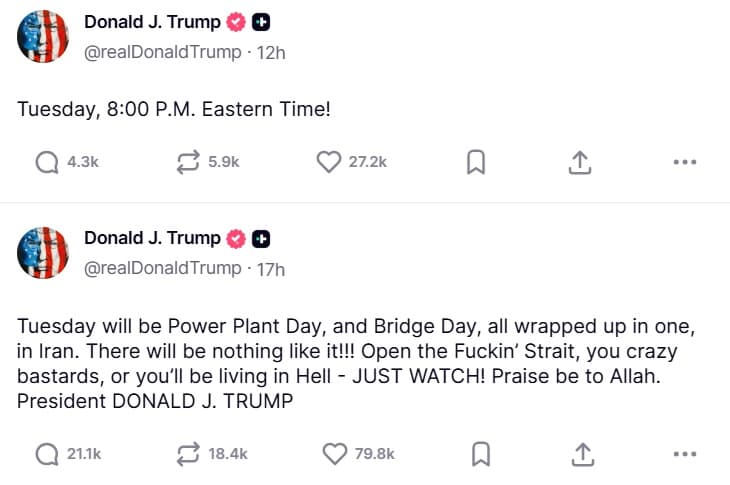
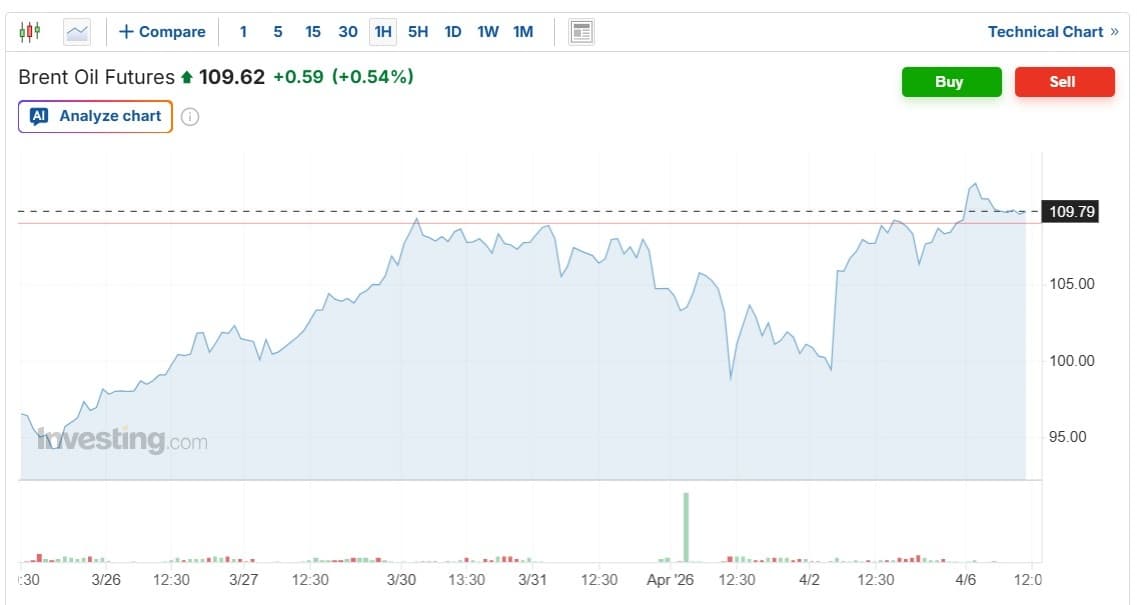
Six weeks in, the Strait of Hormuz is still effectively shut, oil is above $109, and nobody - not the White House, not Wall Street, not the oil traders - knows how this ends. Analysts are now talking about oil at $150 or even $200 if the crisis prolongs into May.
Last week, sentiment was positive as the market wanted to believe that a deal was close. The S&P 500 surged nearly 6%, snapping a five-week losing streak, while the Dow gained 3% and the Nasdaq jumped 4.4%. The question this week is whether they were right.
The Deep Dive
We cover five stories in this week's deep dive.
- S&P 500's war pattern: The Nervous Thursday
- Oil at $200 doesn't sound as absurd now
- Microsoft's worst quarter since 2008. Exxon's best quarter ever.
- Q1 earnings season opens
- Goldman Sachs' new playbook: HALO
Let's take a closer look…
1. S&P 500's war pattern: The nervous Thursday
Since the war began, the S&P 500 has followed an eerily similar weekly script: stocks rally Monday through Wednesday and then fall apart on Thursday and Friday as investors take chips off the table before another weekend of uncertainty.
Here are the numbers: across five weeks, the index cratered a cumulative 9% on Thursdays and Fridays alone.
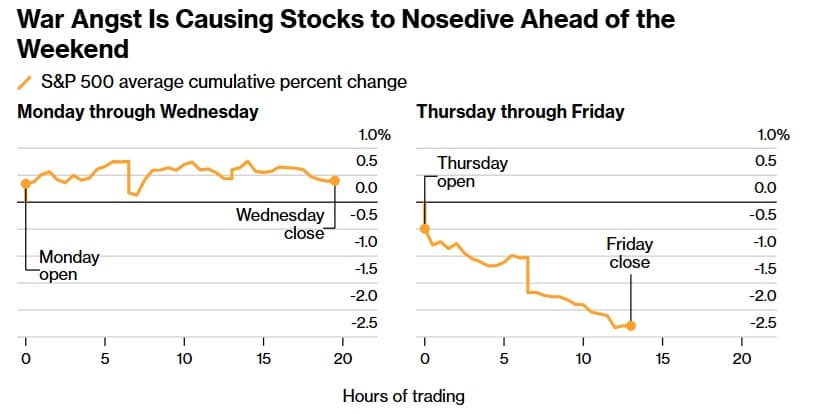
One observation is that Trump has a habit of making his biggest moves when markets are closed, and not many want to be long going into that. As one portfolio manager put it: It has become easier to de-risk into weekends than to hold through them.
Last week was partially different - Thursday was not a collapse. Iranian state media reported that Tehran and Oman were drafting a protocol to monitor Strait traffic, and markets grabbed that headline and held steady. Friday was closed for Good Friday.
The pattern remains more or less intact unless we see a material change on the war front.
2. Oil at $200 cannot be ruled out: Market experts
Two weeks into the war, Iran threatened: That reality, unthinkable then, has started to look plausible as the war enters its 6th week.
JPMorgan thinks oil could hit $120-$130 in the near term. If the Strait stays shut into mid-May, Brent overshoots toward $150. JPMorgan's base case remains a negotiated resolution, with prices pulling back in the second half as flows normalize.
But the explicit warning reads as follows: the longer this goes, the greater the risk of demand destruction and recession. At the time of writing, Brent Oil Futures for June 2026 were trading above $109, up 81% in the last 3 months.
Bloomberg's reporting goes further. In conversations with three dozen oil traders, executives, and advisers, one message kept coming back: the world has not yet grasped how serious this is.
Europe faces diesel shortages within weeks, while Asian buyers are hoarding fuel. And at the extreme end, $200 per barrel is being war-gamed in Washington and on Wall Street.
3. Q1 Earnings: six straight quarters on the line
While the war gets all the headlines, the most important data of the next three weeks will come from corporate earnings calls.
According to FactSet data, the S&P 500 is expected to report earnings growth of 13.2% for Q1 - up from the 12.8% estimated at the start of the year. If that holds, it marks six consecutive quarters of double-digit earnings growth.
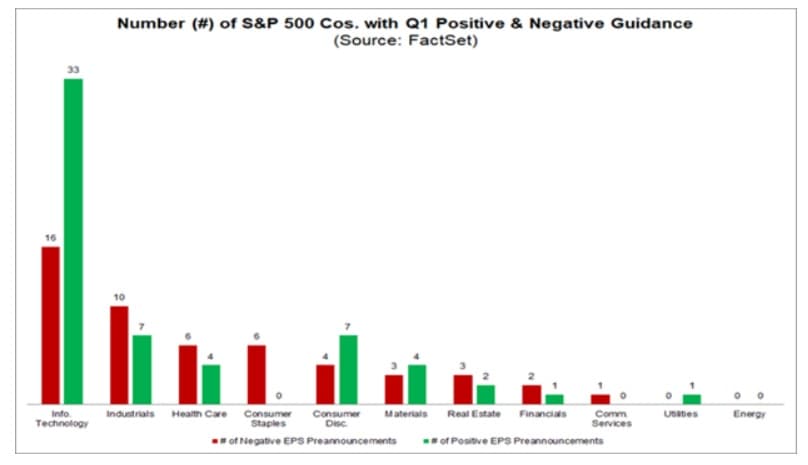
Nine of eleven sectors are projected to show year-over-year growth. More companies have issued positive EPS guidance than negative - 59 versus 51 - above both the five-year and ten-year averages.
The forward P/E has fallen to 19.8, below the five-year average (19.9). The market has gotten cheaper as earnings estimates held firm. That is historically a constructive setup.
4. Microsoft's worst quarter since 2008. Exxon's best quarter ever.
Two numbers from Q1 tell you everything about this market. They relate to two companies - one spent the quarter pouring capital into something the market cannot yet see paying off. The other produces something the world suddenly cannot get enough of.
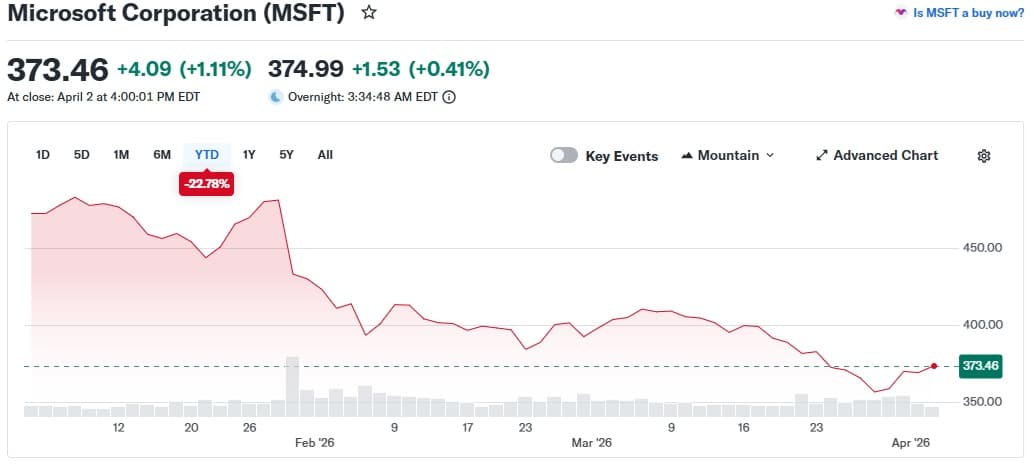
Microsoft fell 23% in the quarter - its worst performance since the 2008 financial crisis, worse than any of its mega-cap peers, worse than the Nasdaq by a factor of three.
The company is spending $146 billion on AI infrastructure in fiscal 2026, a 66% jump from last year. Copilot, the flagship product meant to justify that spend, has 6 million daily users. ChatGPT has 440 million. Azure's growth rate decelerated for the first time in years.
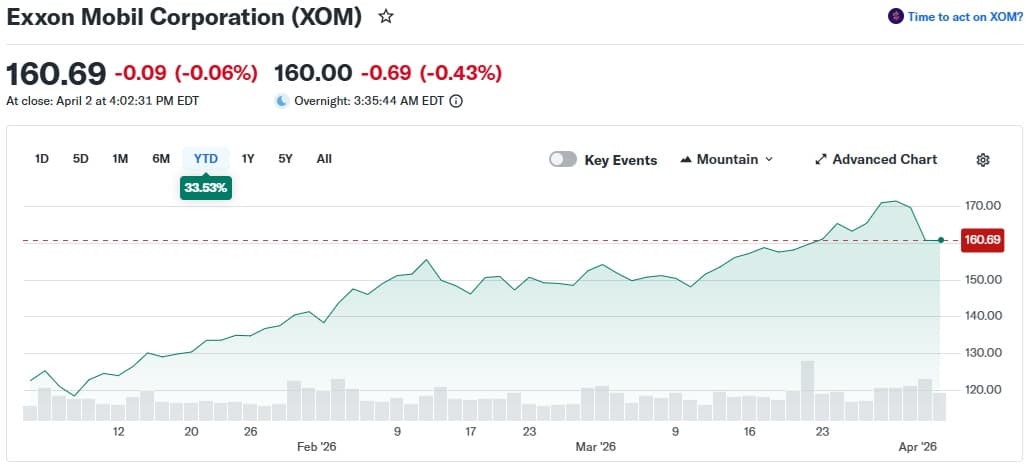
Meanwhile, Exxon Mobil gained 43% in Q1 - its best quarterly performance on record, going back to 1972. ConocoPhillips matched it, its best quarter since 1975.
5. Goldman Sachs' new playbook: HALO
Goldman Sachs has a name for what is happening. They call it HALO: Heavy Assets, Low Obsolescence.
The argument goes like this: for a decade after the financial crisis, cheap money rewarded scalable, asset-light businesses. Software, platforms, digital services - these are companies that could grow without building anything. That era is over.
Higher real yields, geopolitical fragmentation, and now a war that has shut the world's most critical oil chokepoint have repriced what scarcity actually means. The market is now rewarding companies built on assets that take decades to replicate - pipelines, grids, utilities, transport networks, and industrial capacity.
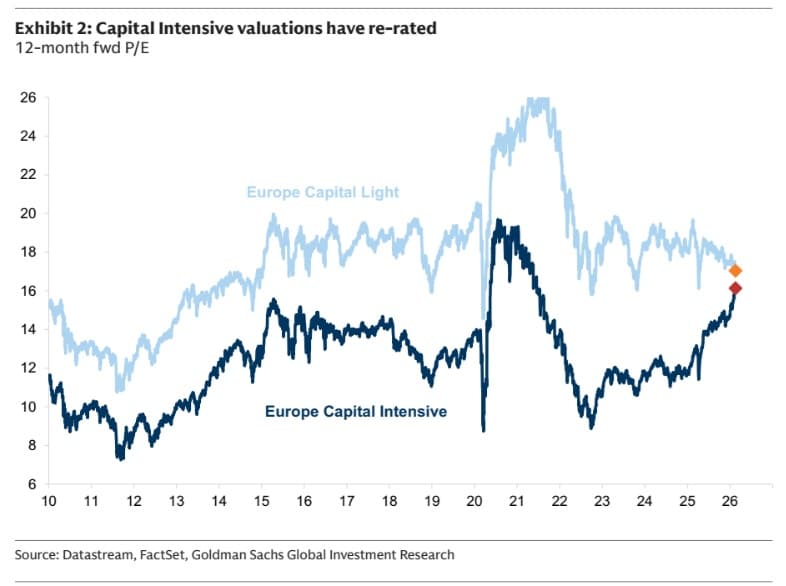
Goldman's Capital Intensive basket has outperformed Capital Light by 35% since 2025.
AI has brought a new twist: it is simultaneously destroying the moats of traditional software businesses by compressing margins and commodifying differentiation, while turning the hyperscalers into the biggest capital spenders in history.
The rotation into physical assets has started, and Goldman's data suggests it is far from over. Long-term allocations to capital-intensive businesses remain far from stretched.
Before we sign-off
Markets move not just on data, but on how investors interpret them. In each of the stories we cover, it all comes down to market expectations and sentiment. When sentiment runs ahead of fundamentals, what follows is volatility.
At AlphaPro, we track the voice behind the numbers and tone of earnings calls, policy speeches, and analyst commentary. Our Earnings Sentiment Score helps you cut through the noise and see how executives and policymakers are shaping narratives in real time.
Same time next week?
See you then.
Want to explore real-time sentiment scores, earnings call insights, and curated stock research?