
Happy Monday! If you just heard a long swooooosh sound, it was probably because last week, Anthropic's Claude Cowork, the company's new AI automation tool, sent a shockwave through the market. Software stocks, especially in enterprise tech, took heavy selling pressure as investors reacted to fears that automation could make parts of enterprise IT obsolete.
That said, some firms are steadily ramping up investment spending. Nine S&P 500 companies have materially increased capital expenditures, reflecting confidence in future growth.
After a strong sell-off early last week, the late-week rebound offered some relief. On a weekly basis, the Nasdaq was down more than 1.8%, and the S&P 500 slipped about 0.1%, but buyers stepped in on Friday before earnings season dominated headlines again. According to Goldman Sachs' trading desk, selling isn't over thanks to systematic strategies, which may keep pressure on stocks this week.
And Q4 2025 earnings are rolling in: roughly 60% of companies have reported actual results so far. FactSet data shows 76% of S&P 500 firms beat EPS expectations and 73% beat on revenue. But here's an important new trend: companies with greater international revenue exposure are posting stronger earnings growth than those that are more U.S.-centric.
The Deep Dive
This week, we highlight five stories shaping sentiment in February:
- These 9 S&P 500 stocks just increased their CapEx significantly
- Goldman traders warn stock selling isn't over in a choppy market
- Four U.S. tech giants are planning to spend up to $670 billion to build out AI infrastructure in 2026
- Companies with more international exposure report higher earnings growth: FactSet
- This AI stock is the newest member of the S&P 500
Let's take a closer look…
1. These 9 S&P 500 stocks just increased their CapEx significantly
Some of the biggest companies in the S&P 500 are spending more on capital expenditures than they have in years. The recent data shows nine firms, including names like Oracle, Arista Networks, and Palantir, have materially lifted investment in property, plant, and equipment over the past 12 months.
Looking at the roster of spenders, sectors vary: some are tech and networking firms leaning into next-generation computing needs. Others are in industrial or infrastructure segments, ramping up their asset base:
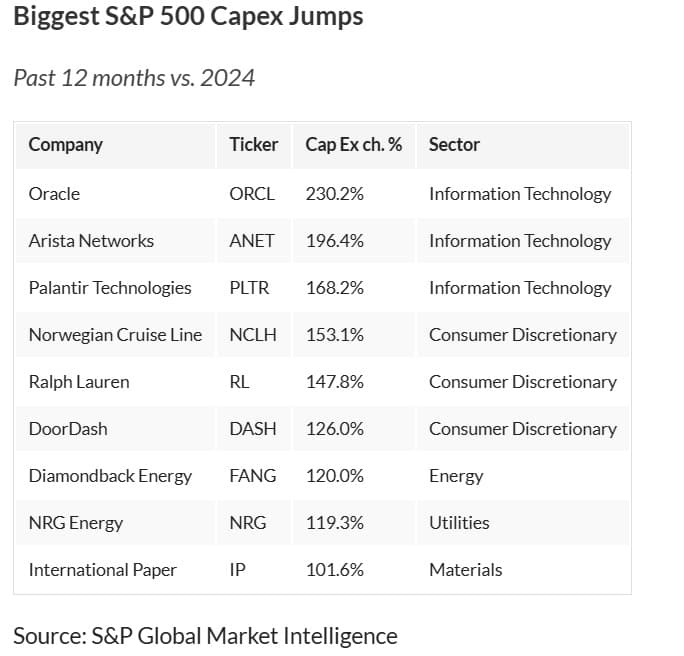
These increases come even as earnings seasons and macro volatility dominate investor attention. Higher capex often shows confidence in long-term demand, but it also means near-term cash flow is being redirected away from buybacks or dividends.
For companies where growth prospects are tied to AI, cloud, networking, or digital transformation, spending now is meant to drive competitive advantage later.
2. Stock selling isn't over in a choppy market: Goldman traders
Goldman's trading desk sees continued selling pressure this week as systematic and trend-following funds remain net sellers. After a bounce on Friday, the S&P 500 has triggered certain technical signals that prompt Commodity Trading Advisers and algorithmic strategies to de-risk positions.
Goldman's team noted that once these systematic flows begin to sell, they can do so independent of fundamentals. The Panic Index has also ticked higher, pointing to rising stress:
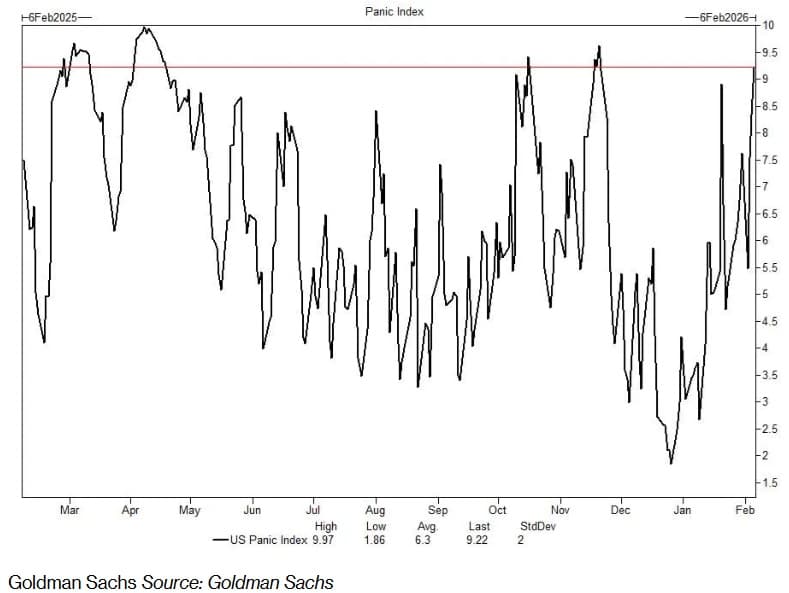
Systematic flows follow price action and volatility, with little regard for earnings or guidance.
If market levels fall below key levels, these trades get unwound mechanically. That means selling could continue regardless of incoming macro or earnings data. From a sentiment standpoint, that adds a layer of negative feedback loops.
3. Four U.S. tech giants are planning to spend up to $670 billion to build out AI infrastructure in 2026
Four of the largest U.S. technology companies have outlined capital expenditure plans that could total as much as $650-$670 billion in 2026, primarily to build out AI infrastructure, data centres, and related technology capacity.
These outlays are among the largest in corporate history outside major public works:
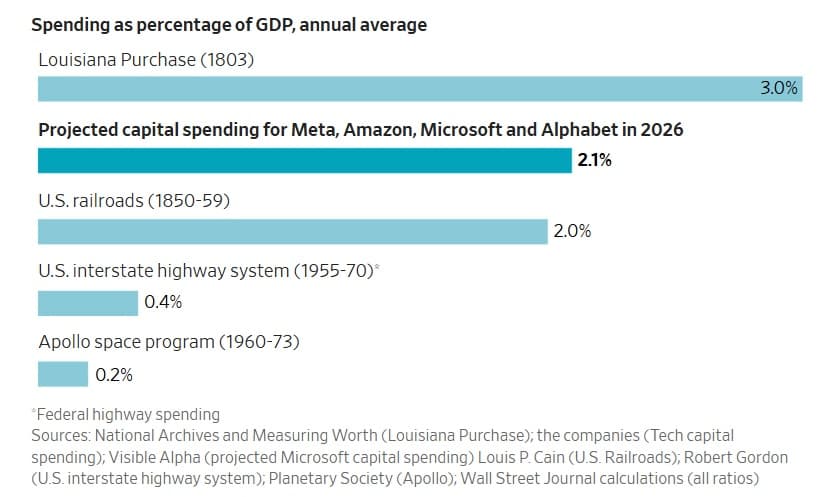
Companies like Amazon, Alphabet, Microsoft, and Meta are each committing massive sums. Amazon alone plans roughly $200 billion in capex this year aimed at AI, robotics, and related systems.
Alphabet's spending is expected to be near $175-$185 billion, largely on data-centre build-outs. Meta and Microsoft have also projected very high outlays for AI infrastructure as they compete for capacity and talent.
4. Companies with more international exposure report higher earnings growth: FactSet
FactSet data shows a clear differentiation in earnings results across the S&P 500 based on geographic sales exposure.
For Q4 2025, companies with more than half of their revenue generated outside the U.S. saw a blended earnings growth rate of about 17.7%, outpacing the 10.0% growth of firms with predominantly domestic sales:
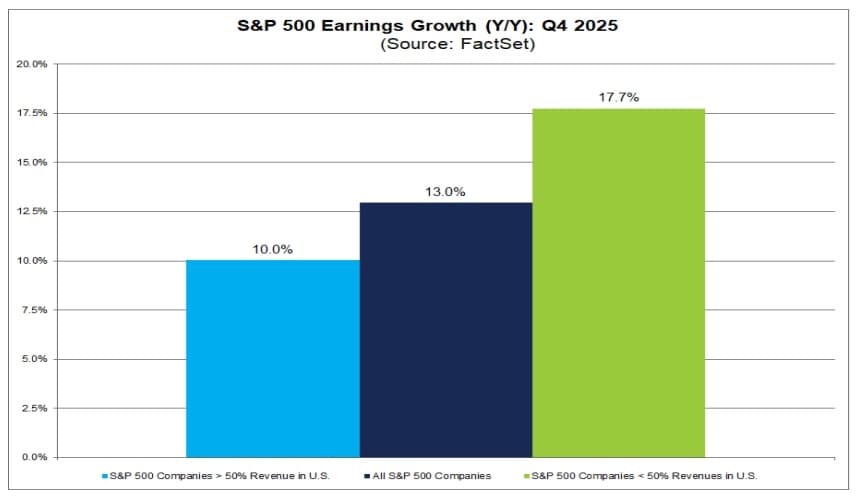
Revenue growth told a similar story: 11.9% for internationally exposed firms vs 7.7% for more U.S.-centric peers.
For investors looking for sources of earnings stability, international exposure is emerging as a tangible differentiator in this earnings season.
5. This AI stock is the newest member of the S&P 500
A networking and telecom equipment maker that supports digital infrastructure will join the S&P 500 this week. Ciena Corporation is moving up from the S&P Midcap 400 to replace Dayforce following its acquisition.
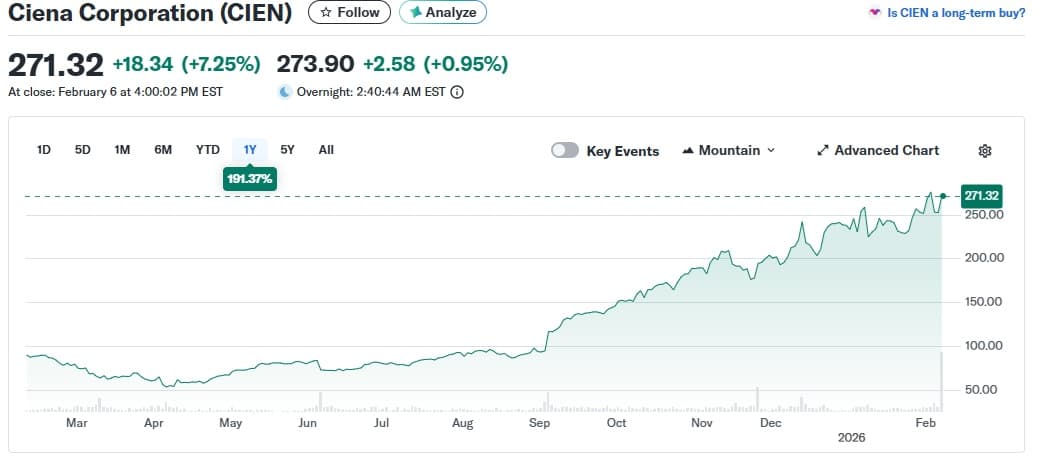
Inclusion in the S&P 500 tends to bring incremental demand from index funds and passive strategies that track the benchmark. Ciena's business focuses on optical networking systems and telecom gear that help carry data traffic for cloud, enterprise, and service-provider customers.
Before we sign-off
Markets move not just on data, but on how investors interpret them. In each of the stories we cover, it all comes down to market expectations and sentiment. When sentiment runs ahead of fundamentals, what follows is volatility.
At AlphaPro, we track the voice behind the numbers and tone of earnings calls, policy speeches, and analyst commentary. Our Earnings Sentiment Score helps you cut through the noise and see how executives and policymakers are shaping narratives in real time.
Same time next week? See you then.
Want to explore real-time sentiment scores, earnings call insights, and curated stock research?