
Happy Monday! Back from Thanksgiving, if you're looking for market opportunities as we head into December, the most interesting story may not be where everyone was looking. It turns out that the unflashy corners of the market delivered the real upside this quarter. While every investor was searching for the next AI stock to pick, a completely different sector posted the strongest earnings performance in Q3.
It wasn't tech, software, or semiconductors. It was health care.
Also, in case you were wondering why the market keeps going up after every shake-off, we may have a clue. The latest ETF flow data shows that weekly U.S. equity ETF flows after down weeks for the S&P 500 have been about 17% higher this year than usual. Investors are buying into every dip!
Overall, November proved to be a choppy month for the market. The Nasdaq snapped its seven-month winning streak with a nearly 2% loss, while the S&P 500 slipped 0.6% after six straight months of gains. The Dow was roughly unchanged for the month.
A cooldown in megacap tech names dragged indices lower as investors are closely watching how quickly AI-driven businesses can go beyond hype and achieve sustainable profits.
But on the earnings front, the story is still strong. With 95% of S&P 500 companies having reported Q3 results, 83% have delivered a positive EPS surprise, while 76% have reported a positive revenue surprise.
The Deep Dive
This week, we are tracking three key stories:
- Health care: The unflashy sector that led Q3 earnings
- Investors are buying the dips more aggressively this year
- AI fatigue? The "Magnificent 7" just posted their weakest earnings growth since Q1 2023
Let's take a closer look…
1. Health care earnings top S&P 500 with the most earnings surprises in Q3
While everyone was focused on AI, health care quietly delivered one of its strongest quarters in more than 4 years. Higher usage of new and specialty drugs, continued demand for weight-loss treatments, and strong hospital visitation trends helped the sector outperform all others in Q3.
Among the 11 industry groups in the S&P 500, health care companies posted the highest percentage of earnings beats:
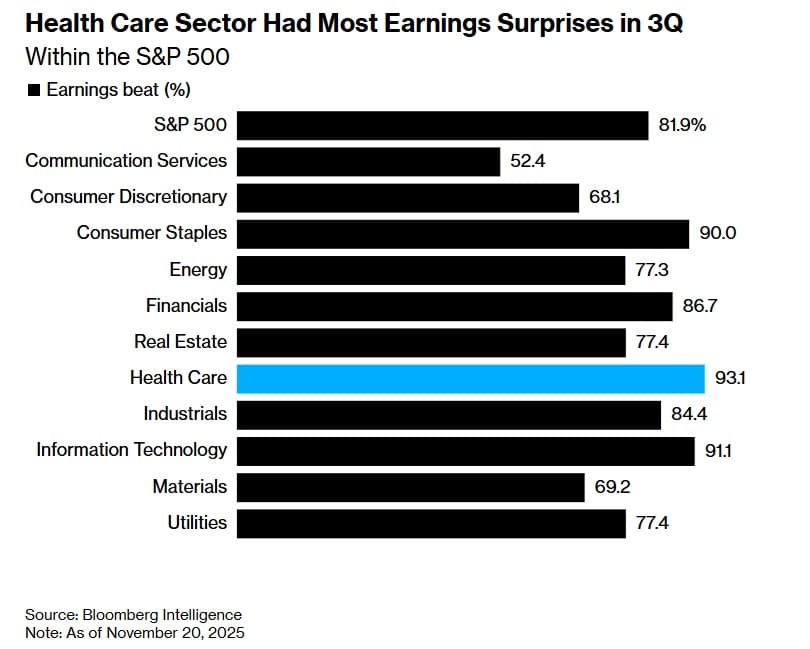
According to FactSet, the health care sector has been the single largest contributor to the rise in the S&P 500's revenue growth rate since September 30, accounting for about 20% of the total increase. Several large companies in this space, including Cardinal Health, CVS Health, Centene, Cigna, and Eli Lilly, reported significant revenue surprises. As a result, blended revenue growth for the sector climbed to 10.4%, up from 8.0% at the end of the quarter. That's an outstanding performance for an industry traditionally viewed as defensive.
2. Investors are buying the dips more aggressively this year
In case you've been wondering why every market correction keeps bouncing back almost instantly, here's the answer. BlackRock's data shows that U.S. equity ETF flows have consistently surged on weeks when the S&P 500 has been negative.
Weekly flows after down weeks have been 17% higher this year than the average, meaning that investors haven't been deterred by volatility at all:
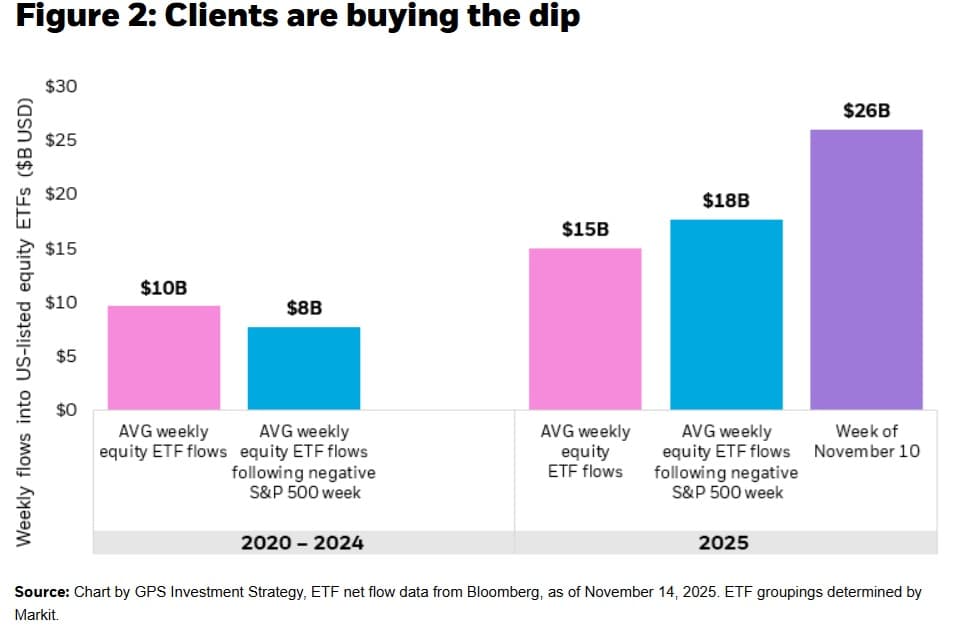
That trend showed up clearly during the week of November 10, when U.S.-listed ETFs pulled in about $26 billion in net inflows; roughly double the average weekly flow for 2025. This shows the resilience in the underlying market: investors are not scared of market weaknesses, and that steady bid has quietly supported the market throughout the year.
3. Signs of AI fatigue? The "Magnificent 7" reported the lowest earnings growth since Q1 2023
With NVIDIA reporting on November 19, all members of the have now released Q3 numbers. But the truth is that the AI momentum that defined the past year looks like it's slowing. On September 30, the estimated earnings growth rate for the group was 14.7%. In the end, 71% of the companies beat EPS expectations, compared to 83% for the broader S&P 500. Their actual earnings growth for the quarter came in at 18.4%, well below the average rate of 28.8% over the previous four quarters.
Another interesting observation by BlackRock is that companies that missed expectations tended to see sharper declines than usual. And those that beat earnings saw more muted reactions compared to previous quarters. This shift is a potential sign of investor fatigue in AI-linked names.
BlackRock notes that the cooling earnings momentum and the softer market reactions could indicate that investors are becoming more selective (or simply more skeptical) about the pace of AI monetization. It will be interesting to see whether this becomes a trend or just a pause.
Before we sign-off
Markets move not just on data, but on how investors interpret them. In each of the stories we cover, it all comes down to market expectations and sentiment. When sentiment runs ahead of fundamentals, what follows is volatility.
At AlphaPro, we track the voice behind the numbers and tone of earnings calls, policy speeches, and analyst commentary. Our Earnings Sentiment Score helps you cut through the noise and see how executives and policymakers are shaping narratives in real time.
Same time next week? See you then.
Want to explore real-time sentiment scores, earnings call insights, and curated stock research?