
Happy Monday! The Q2 earnings season is winding down, and with almost all the reports in, the results have been broadly positive. Companies entered Q2 with lowered expectations as analysts were calling for just 5% earnings growth, the slowest since Q4 2023. Worries about tariffs, pricey stock valuations, and the risk of a slowdown kept expectations in check.
While the bar may have been low, corporate America has cleared it with enough room to spare. More than 92% of S&P 500 companies have reported results, with earnings per share on track to grow about 11% year-over-year. That marks the third consecutive quarter of double-digit EPS growth, showing that despite macro headwinds, profitability is still strong.
With all this in play, the coming week will be an important one for US markets, with three key developments likely to drive sentiment.
The Deep Dive: Fed Signals, Nvidia, and Intel in Focus This Week
This week, we are tracking three key events that could shape markets in the days ahead:
- The Fed signaling a September rate cut;
- Trump Administration's unusual move to buy nearly 10% of Intel;
- And, the AI boom's litmus test with Nvidia's earnings this Wednesday.
Let's take a closer look…
1. The Fed May Cut Rates, but Has the Market Already Priced It In?
At Jackson Hole last week, Federal Reserve Chair Jerome Powell hinted that September could bring the first interest rate cut in almost a year. He acknowledged while inflation risks remain tilted to the upside. The Fed has kept rates between 4.25% and 4.50% since December, but Powell signaled that with easing inflation and a cooling labor market,
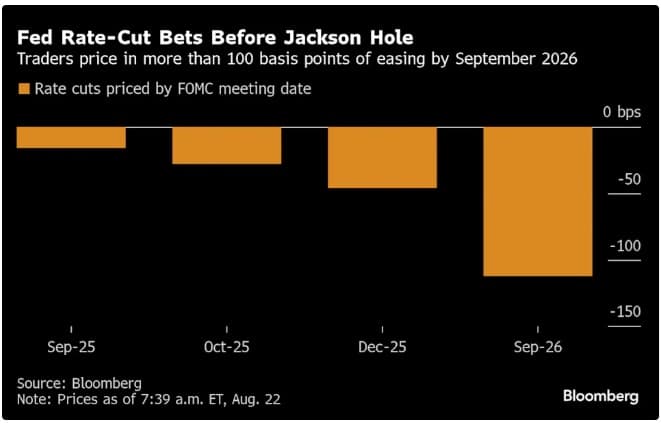
Markets were quick to respond, with 10-year Treasury yields dipping from 4.31% to 4.26%. Stocks rallied on Friday, with the Dow up nearly 2%, the S&P 500 climbing 1.6%, and the Nasdaq gaining 1.9%, bouncing back from earlier weakness in tech stocks.
Still, at this point, it probably makes sense to keep an eye on the details: core inflation remains at 3.1%, above the Fed's 2% target, and August jobs data could complicate the picture. Earlier, Treasury Secretary Scott Bessent had advocated for a 50 bps cut, arguing the Fed missed an opportunity earlier in the summer. But then others cautioned against moving too aggressively while inflation remains sticky.
That said, the market may have run ahead of the Fed. This means a 25 bps cut is now almost fully priced in. On the flipside, if the Fed disappoints, equities could face turbulence despite the Fed's dovish tone.
2. Washington Invests in Intel, But Can It Buy Time?
In a rare intervention, the U.S. government is taking a 9.9% stake in Intel, injecting nearly $9 billion into the struggling chipmaker. The move is in alignment with the White House's broader strategy to rebuild domestic semiconductor capacity, lower its reliance on Asian suppliers, and bring advanced manufacturing back to the US.
Intel's stock jumped 5.5% on the announcement. Capital infusion is likely to support the company's push into contract chipmaking, with high-volume production of advanced nodes (14A and 18A) scheduled to begin in Arizona. Intel has already pledged $100 billion to expand its U.S. factories.
But analysts remain divided. Summit Insights' Kinngai Chan warned: Intel has been playing catch-up after ceding its manufacturing lead to Taiwan's TSMC and losing ground in AI chips to Nvidia. Without a steady pipeline of external customers, the foundry business may struggle to achieve scale, regardless of government support.
Some, however, see this as an opportunity. said Peter Tuz of Chase Investment Counsel. Government backing could help Intel bridge the gap until new technologies and customer contracts take hold.
The key takeaway is that while Intel now has political capital and financial support, that alone won't solve its competitive challenges. Washington can buy Intel time, but only customers can buy its chips.
3. Is 'AI Hype' Cooling Off? Nvidia's Earnings This Week May Decide
No theme has recently dominated Wall Street like Artificial Intelligence (AI). Since late 2022, when OpenAI's ChatGPT captured global attention, investors have poured into AI-linked names. Nvidia has been the face of the boom: its stock has risen nearly 1,100% since early 2023, making it the world's most valuable company.
But some see cracks in the AI narrative. Last week, the Nasdaq slipped more than 2% by mid-week, led by sharp declines in Nvidia, Palantir, and other AI leaders. Part of the skepticism stems from the technology itself. Meta delayed the rollout of its next flagship AI model, citing limited progress. OpenAI's GPT-5 arrived later than expected and failed to deliver the breakthroughs many were keenly waiting for. It's far from AGI, whatever that does mean.
Analysts warn that progress may be flattening at least in the near term, and that sets the stage for Nvidia's earnings on Wednesday, August 27. The company's near-parabolic run has priced in nonstop growth and demand. This means even a small sign of weaker sales or cautious guidance could lead to a sharp pullback not just in Nvidia, but in tech stocks in particular and the broader market too.
Before we sign-off
Markets move not just on data, but on how investors interpret them. In each of the stories we cover, it all comes down to market expectations and sentiment. When sentiment runs ahead of fundamentals, what follows is volatility.
At AlphaPro, we track the voice behind the numbers and tone of earnings calls, policy speeches, and analyst commentary. Our Earnings Sentiment Score helps you cut through the noise and see how executives and policymakers are shaping narratives in real time.
Same time next week? See you then.
Want to explore real-time sentiment scores, earnings call insights, and curated stock research?