By fusing sentiment, price, and volume, we can finally quantify what intuition has sensed all along.
If you've ever listened to an earnings call, you know the numbers hide as much as they reveal. The word choices, the awkward pauses, and the tone often say much more. For instance, when a CEO says rather than the shift may not sound like a deal-breaker. But for trained ears, it's anything but. For decades, analysts have relied on these cues to read management's conviction. With models like AlphaPro.ai, we can now interpret both text and tone and convert intuition into a single data point: an earnings sentiment score.
Platforms like AlphaPro take hours of earnings calls — including every question, hesitation, and inflection — and translate them into a sentiment score. It's a single quantitative measure reflecting how optimistic or cautious a management team sounds.
Our backtesting data shows that the sentiment score itself works effectively as a leading indicator of stock performance. But when we combine the score with price and volume, it becomes even more powerful, capturing both the psychological pulse of management and the real-time behavior of the market.
The subtext of an earnings call
Academic research, including often-cited work from the University of California, Berkeley and Wharton, has shown that what executives say — and how they say it — can foreshadow stock performance. One study, involving 100,000 transcripts of earnings calls from 6,300 public companies from January 2010 to December 2019, found that firms using more optimistic language in earnings calls tend to outperform those that sound defensive or evasive, at least in the days immediately following the call.
That shouldn't come as a surprise to anyone who's spent time reading transcripts. No one doubts that executives have more real-time visibility into their business than anyone else. So, when their tone subtly shifts — for instance, when becomes — that subtle linguistic change often reflects something happening under the hood.
But here's a nuance: a positive tone may not move the market if the market doesn't believe it. So, to build a truly predictive signal, you have to look at how tone interacts with market behavior — specifically, price and volume.
When words meet the market
Let's take an example. Suppose a company like Meta sounds unusually upbeat during its quarterly call and talks about strong ad revenue trends and cost optimization. AlphaPro's sentiment engine scores the call as highly positive compared to previous quarters. But over the next few hours, the stock barely moves.
Does that mean the model was wrong? Not necessarily. Research on post-earnings announcement drift — the slow reaction of markets to new information — suggests that investors often underreact to qualitative cues at first. When sentiment diverges from short-term price action, it can sometimes point to an opportunity. If, over the next few days, trading volume quietly builds and the stock begins to trend higher, that initial tone analysis turns into a leading indicator.
On the other hand, think of a situation where sentiment scores turn negative even as prices surge. This mismatch often precedes exhaustion — indicating that enthusiasm in the price isn't matched by management confidence.
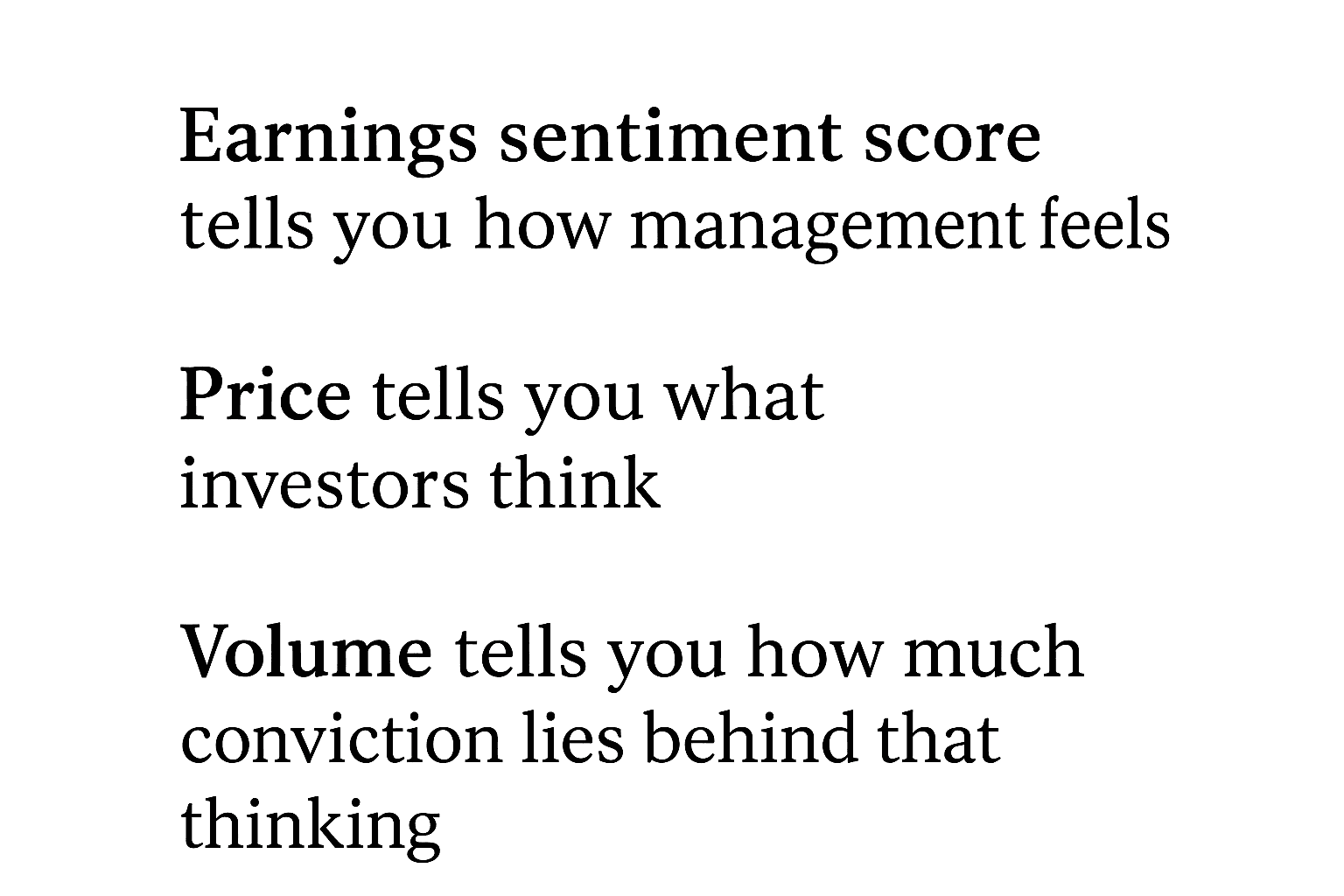
That's why a three-layer lens — combining tone, price, and volume — gives a more complete view:
- Tone tells you how management feels.
- Price tells you what investors think.
- Volume tells you how much conviction lies behind that thinking.
The probability of a meaningful move rises when all three work in sync.
Why pairing tone with microstructure works
Berkeley's research on financial text points to something intuitive and significant: tone becomes predictive when it's validated by trading behavior. If a CEO sounds unusually positive but trading volume stays flat, it may signal that the market is skeptical. On the other hand, a positive tone accompanied by heavy, informed buying suggests that institutional investors are buying the message — often before retail traders have a clue.
This interesting interplay between language and liquidity explains why combining AlphaPro's sentiment data with price and volume can produce stronger, more reliable signals than text alone. Because while the earnings sentiment score gives you motive, the microstructure gives you evidence. It's the same principle underlying behavioral finance: prices move not just on information, but on how people interpret it. Tone gives context to that interpretation.
Interestingly, Wharton researchers found that sophisticated traders — such as hedge funds and short sellers — tend to exploit these insights. When management sounds too upbeat after a big earnings beat, experienced investors often take it as a warning sign, assuming the tone might be covering something up. On the other hand, when executives sound measured or cautious even after strong results, it can signal they're grounded in the company's fundamentals. And that's when smart money starts accumulating.
Turning research into practice
For investors, the practical takeaway is this: instead of looking at sentiment in isolation, analyze how it interacts with market data in real time. When a company's AlphaPro sentiment score spikes higher than its historical average, watch whether the stock confirms that optimism through rising prices and expanding volume.
Similarly, a negative sentiment reading accompanied by falling prices and high trading volume can reinforce a bearish setup. But if sentiment turns down while the stock holds steady, it might signal that the worst is already priced in.
The beauty of this approach is that it merges behavioral cues with market signals, grounding intuition in data.
In the end, the language of finance has always been more than numbers. Markets don't move purely on reported earnings; they move on belief, confidence, and trust. By combining sentiment data with the hard evidence of price and volume, investors can bridge two worlds: the human and the quantitative. It's a new variant of what analysts have always done: listening carefully, reading between the lines, and acting before the crowd does.