Thematic ETFs often put exciting stories under a single wrapper. But they have a timing problem — they often arrive when the underlying stocks are overvalued.
Great ideas, much like great companies, don't always become great investment theses.
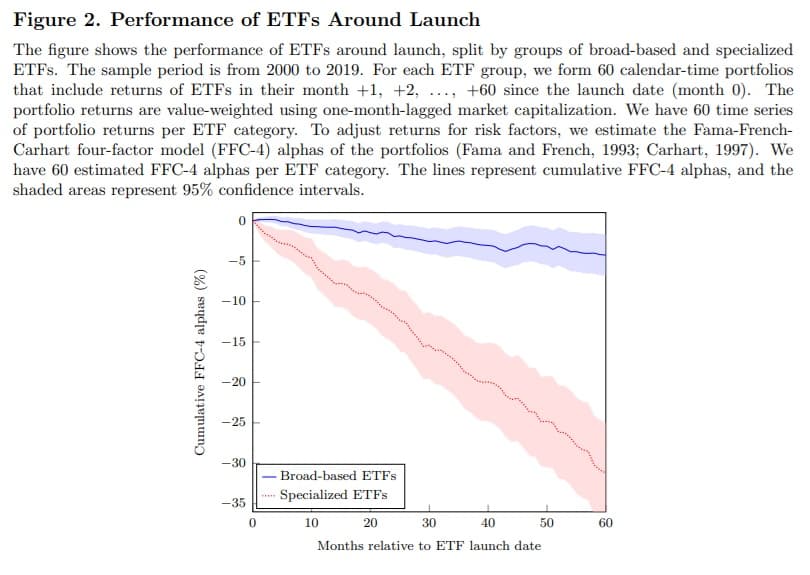
Consider this: over their first five years, specialized ETFs have underperformed by roughly 30% on a cumulative risk-adjusted basis. One reason may be that they're often launched only after a theme has already captured investors' attention.
To be fair to ETFs, they have solved a genuine problem. Twenty years ago, if you wanted to get exposure to an emerging industry, your best chance was to bet on a series of stocks, knowing fully well that most of them probably wouldn't work out. Today, you can have the same exposure with a single fund.
ETFs made diversification simpler, cheaper, and accessible to almost everyone. If artificial intelligence changes the way businesses operate or if robotics finds its way into every factory on earth, who wouldn't like to own those themes as a sensible investment? This year alone, more than $100 billion has flowed into technology and thematic ETFs, much of it chasing AI, semiconductors, defense, robotics and a handful of other equally exciting theses.
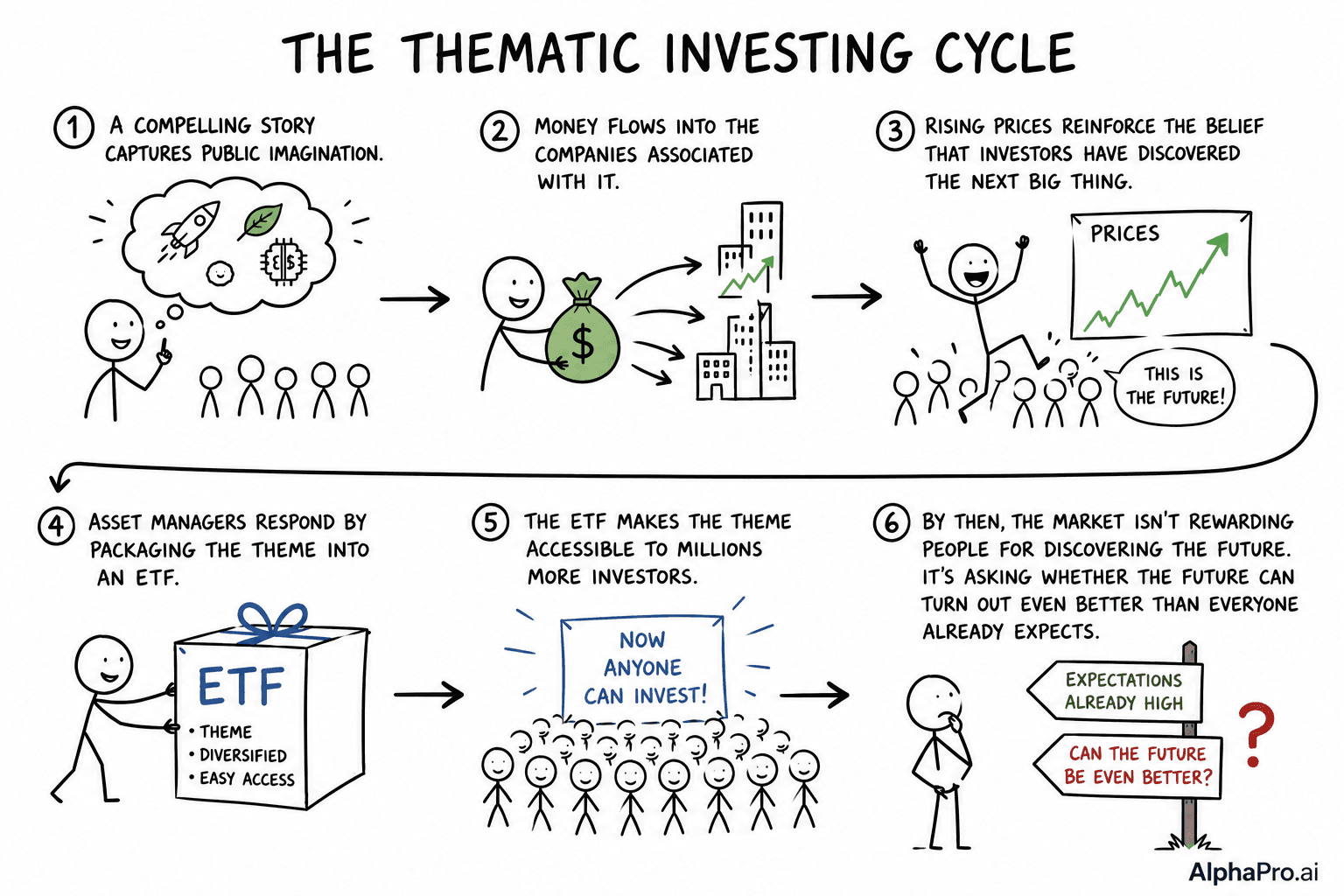
The problem begins when we confuse diversification with timing. Most thematic ETFs are created when a theme has already become popular, captured investor imagination, and valuations have been bid higher.
Why Thematic ETFs Launch When They Do
The launch of a thematic ETF usually tells you one thing: investors are already interested in the theme.
In fact, the very existence of a thematic ETF is often evidence that a theme has already gone mainstream. Asset managers don't simply wake up one morning and decide there should be an ETF for robotics or cybersecurity.
They wait for money to move into the sector, or for analysts to make increasingly optimistic forecasts. Once everyday investors become convinced that a particular technology is going mainstream, it starts to make commercial sense to build a product around it.
It's business 101: every business responds to demand.
So, by the time an investment theme has generated enough enthusiasm to justify its own ETF, chances are that the valuation of underlying stocks has already skyrocketed. The investment euphoria that makes a thematic ETF commercially viable may also be the reason future returns become increasingly elusive.
In a recent paper titled researchers Itzhak Ben-David, Francesco Franzoni, Byungwook Kim and Rabih Moussawi reached much the same conclusion after studying the evolution of the ETF industry. They found that specialized ETFs are typically launched after the underlying stocks have already attracted significant investor attention, favorable media coverage and strong past returns.
Over the next five years, those funds went on to underperform by roughly 30% on a cumulative risk-adjusted basis. The explanation wasn't higher fees or poor diversification but the fact that the underlying stocks were already expensive when the ETFs came to market.
To quote from the paper itself:
"Our results suggest that specialized ETFs, on average, do not create value for investors. These ETFs tend to hold attention-grabbing and overvalued stocks and therefore underperform significantly: They deliver a negative annual alpha of about −6% in the five years after their inception, on average. We find no evidence that the negative performance corresponds to the price that investors are willing to pay to insure against relevant risk factors, or that they are willing to pay a premium for some non-pecuniary benefits."
Great Technology Doesn't Always Make a Great Investment
Looking at the history of the stock market, every decade seems to have its own version of the investment theme.
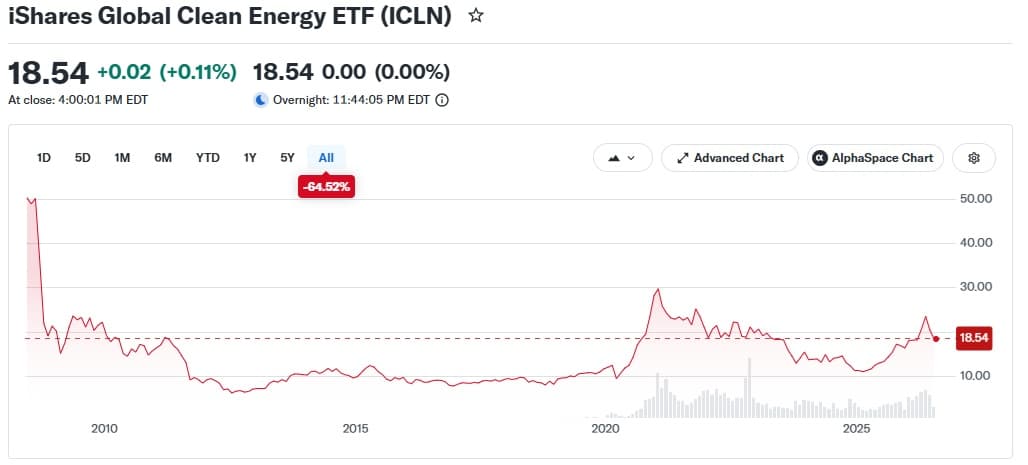
Twenty years ago, governments around the world were investing heavily in renewable energy. Solar installations were growing at record rates, and investors believed fossil fuels would soon become relics of the past. Many of those predictions came to be true.
Renewable energy expanded rapidly, and solar panels became dramatically cheaper. Countries have continued transitioning toward cleaner sources of power. Many of the companies that investors rushed to own, however, struggled under intense competition, falling margins and lofty valuations. Several clean-energy ETFs delivered returns that bore little resemblance to the optimistic headlines that had fueled their popularity.
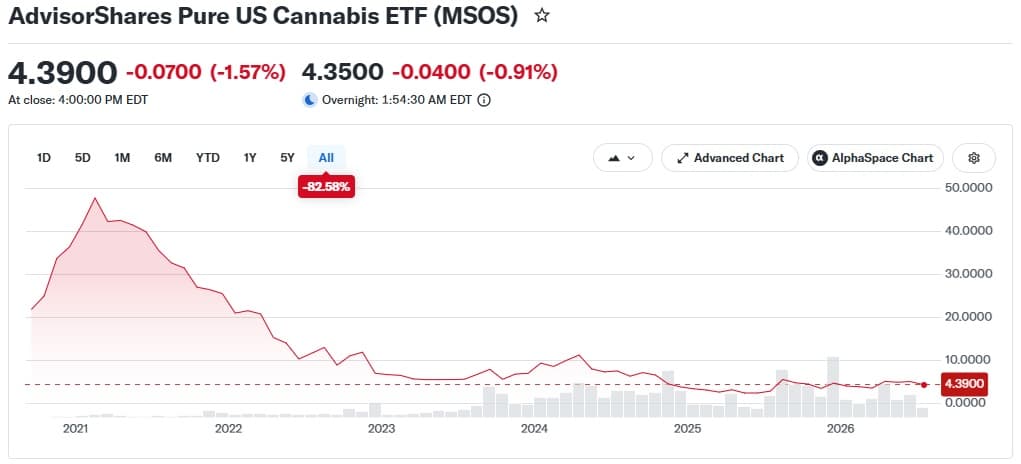
Cannabis ETFs replayed the same story.
With legalization in many US states, analysts projected a multibillion-dollar industry, which soon led to a glut of marijuana ETFs. The industry eventually grew, but not nearly fast enough to justify the expectations around many of the stocks. Oversupply, regulatory hurdles, and disappointing profits eventually replaced the early optimism. Several cannabis-themed ETFs eroded substantial value within just a few years.
Today, artificial intelligence, semiconductors and defense occupy the same place that clean energy and cannabis once did in investors' imaginations. There are currently 92 AI-related ETFs in the US alone. Tomorrow, the spotlight is likely to belong to something else, and the same story is likely to get repeated:
Capital floods into the companies associated with the story. Valuations rise. And then asset managers respond by launching products that allow everyone else to participate. By the time the theme becomes investable through an ETF, much of the optimism has already found its way into prices.
Why Exciting Stories Are So Hard to Resist
The success of thematic ETFs ultimately says as much about investor psychology as it does about financial innovation.
Researchers Ben-David, Franzoni, Kim and Moussawi argue that specialized ETFs are designed to appeal to what psychologists call extrapolative beliefs. We tend to assume that whatever has happened recently will continue happening in the future.
So when artificial intelligence dominates headlines, or clean energy becomes the center of government policies, it becomes surprisingly easy to believe that the companies attached to those themes, even tangentially, can only continue moving in one direction.
The ownership data paints an equally interesting picture.
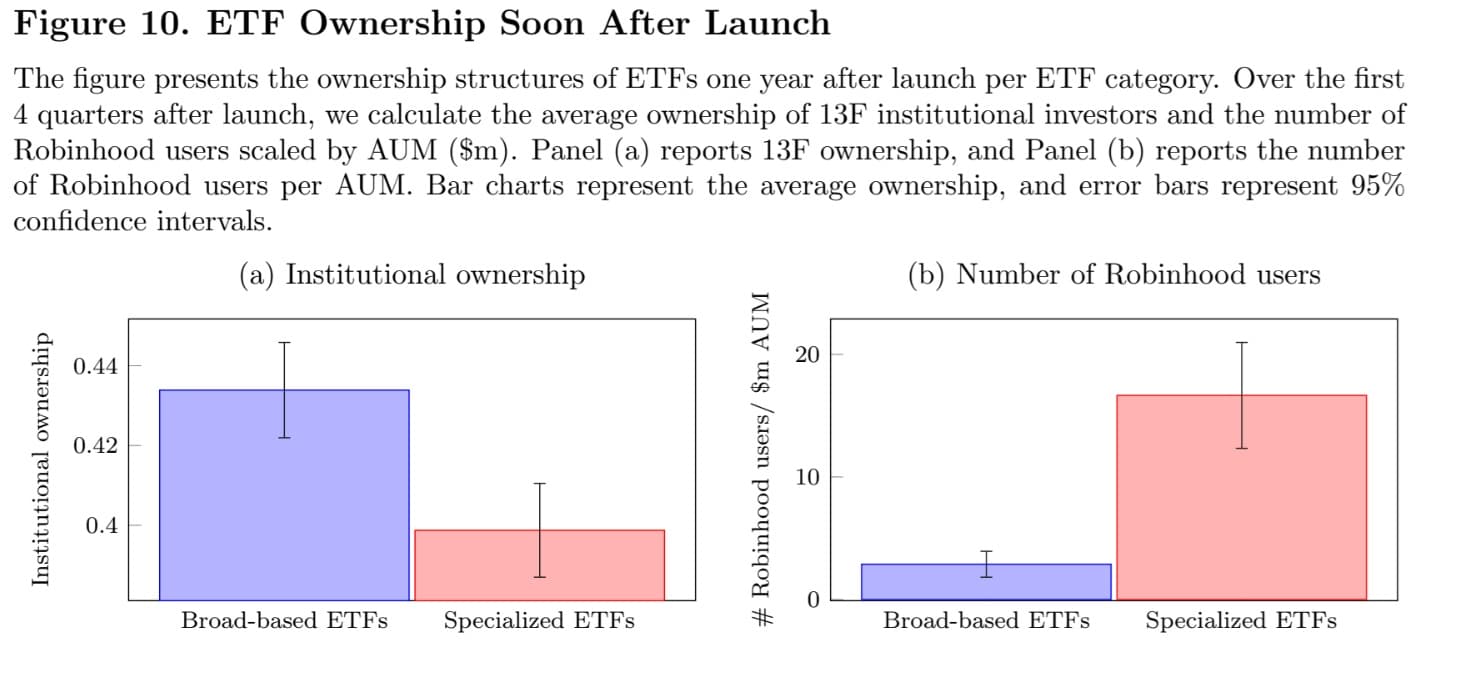
One year after launch, specialized ETFs continue to attract noticeably less institutional ownership than broad-based ETFs, while drawing significantly greater participation from retail investors. Measured relative to assets under management, Robinhood users own specialized ETFs at several times the rate of broad-market funds.
In other words, even after the initial excitement surrounding a new fund has faded, thematic ETFs appear to resonate far more with individual investors drawn to compelling investment stories than with professional portfolio managers.
The problem is that the very signals that make a theme attractive to investors are generally the same signals suggesting sky-high expectations. By the time a specialized ETF reaches the market, the underlying stocks have typically enjoyed strong price appreciation, favorable media, and high expectations.
Analysts, too, tend to have optimistic long-term growth forecasts at precisely this stage. In the next few years, those forecasts are gradually revised downward as reality catches up with expectations.
Thematic ETFs have made it remarkably easy to invest in tomorrow's biggest ideas. The challenge is that markets often recognize those ideas long before the rest of us do. By the time an investment theme becomes easy to buy, much of its promise may already be reflected in its price.