If you ask any financial advisers about what a balanced portfolio looks like, chances are that they would recommend a time-tested portfolio strategy: 60% stocks and 40% bonds.
The classic 60/40 portfolio has been the default allocation for balanced investing for nearly half a century. It is rooted in the Modern Portfolio Theory, pioneered by Harry Markowitz in the 1950s (over 70 years ago). The foundational concept of balancing growth assets with defensive ones also emerged from that theory.
Every investing strategy that succeeds for such a long time eventually gets treated like a law of physics. Unlike laws of physics, however, the 60/40 allocation only works under certain conditions. It was designed for a specific kind of market: a market in which stocks and bonds moved in opposite directions.
But that relationship has changed over time.
Why the 60/40 Portfolio Became the Default
One reason the 60/40 portfolio became so widely popular is that it is based on an easy-to-understand logic. You expect stocks to generate long-term growth, whereas bonds give you regular income. More importantly, bonds tend to cushion your portfolio when equities take a beating. So, we typically don't expect both stocks and bonds to perform badly at the same time.
For much of the past four decades, that expectation proved largely correct. When stocks fell, bonds acted as a counterbalance and helped investors ride through periods of high volatility without changing their portfolios. That also spared investors the impossible task of predicting recession interest rates, and the next big crash. You could simply stay invested and just rebalance from time to time.
The track record was equally convincing. Janus Henderson's Balanced Fund, an $11 billion portfolio that has followed a broadly similar balanced strategy since 1998, has lived through the dot-com crash, the global financial crisis, the pandemic, and several smaller market corrections. Over that period, it outperformed cash in 75% of rolling one-year periods and by 22% over rolling three-year periods.
But beyond the historical record showing the effectiveness of this simple portfolio, a more important question to ask is
So, What Made It Work?
If you ask someone why the 60/40 strategy worked so well, chances are they would point to diversification. Diversification is certainly part of the answer. Historically, stocks and bonds have moved in opposite directions, helping one asset class offset losses in the other. It also made your investment journey smoother without giving up too much long-term growth.
But diversification wasn't the only reason behind its success.
There was another force that helped the 60/40 model gain its popularity: steadily falling interest rates.
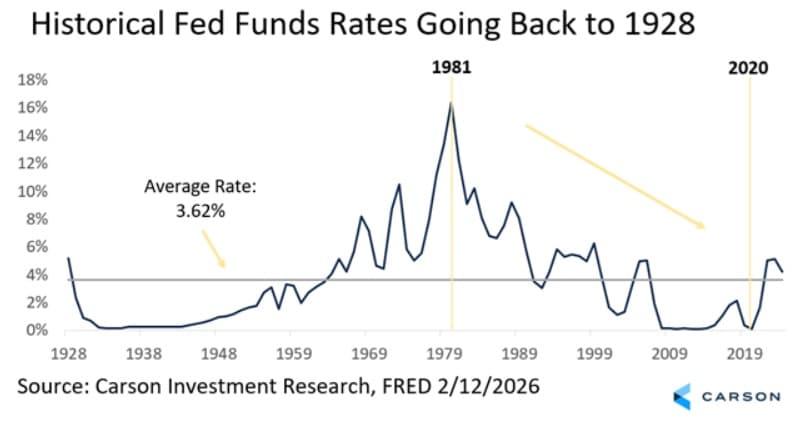
Research by Harry McDonald, which tracks the performance of the 60/40 portfolio back to 1928, shows something worth taking a closer look at. Over the entire period, the portfolio delivered an average nominal annual return of around 9%, or about 5.8% after adjusting for inflation. Though impressive by any standard, the numbers weren't spread evenly across history.
The strongest performance came between the early 1980s and the late 2010s, coinciding with the exact period during which interest rates declined from double-digit levels to near zero. Falling rates did more than lower borrowing costs; they pushed bond prices higher. Bonds were no longer just generating regular income; they were also producing capital gains.
At the same time, inflation remained relatively low and stable. Combined, these factors created an environment in which stocks and bonds complemented each other remarkably well.
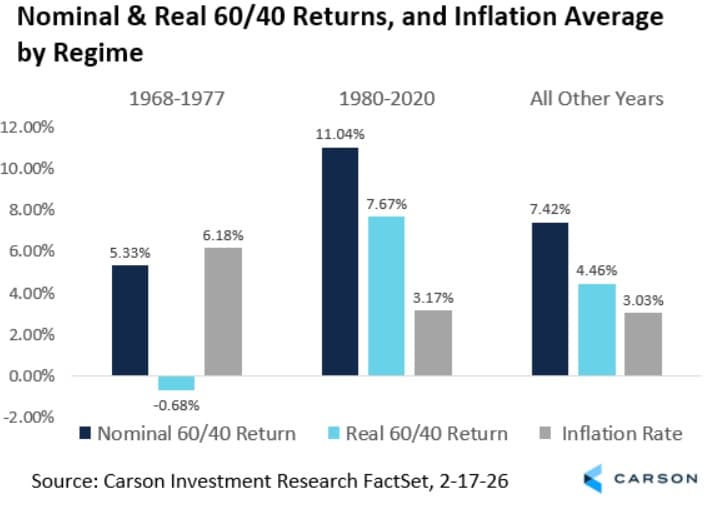
The picture flips when you zoom in on periods of rising inflation and higher interest rates. During the stagflation years between 1968 and 1977, the 60/40 portfolio struggled to preserve investors' purchasing power. Even though nominal returns were positive, an average inflation of over 7% turned real returns negative.
Investors got a reminder of that in 2022 when the Fed raised interest rates aggressively to contain post-pandemic inflation. Stocks lost around 18%, bonds declined by nearly the same amount, and the traditional 60/40 portfolio finished the year down roughly 18%. After adjusting for inflation, the real loss was closer to 24%.
Then Stocks and Bonds Started Moving Together
In 2022, when the Fed sharply raised rates, stocks and bonds fell together. The S&P 500 lost about 18% during the year, while ten-year Treasury bonds declined by almost the same amount. Investors who expected bonds to cushion the fall discovered that their traditional safety net had also come under pressure.
But it will be unfair to question a time-tested strategy because of just one difficult year. Markets occasionally behave in unexpected ways. The more important question is whether 2022 was an exception or a sign that something has fundamentally changed.
Recent research suggests it may be the latter.
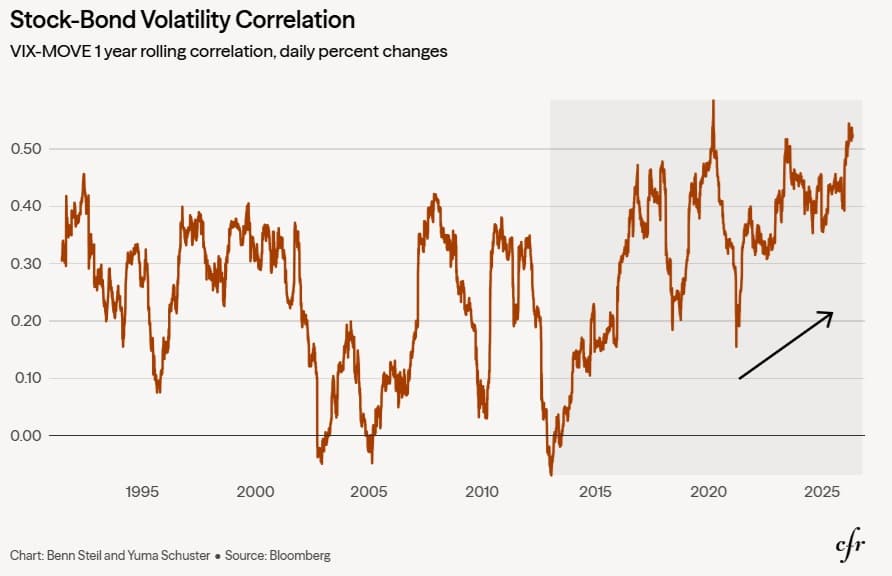
A study by Benn Steil and Yuma Schuster of the Council on Foreign Relations examined the relationship between the VIX, which measures expected stock market volatility, and the MOVE Index, its equivalent for the Treasury market. Before 2013, the two typically moved together only during periods of severe market stress, such as the dot-com crash or the global financial crisis. Once those episodes passed, the relationship weakened again.
Since around 2013, however, that pattern has gradually changed. The correlation has remained persistently higher after every market shock, and today the one-year rolling correlation stands above 0.5, a level that was once associated only with major crises.
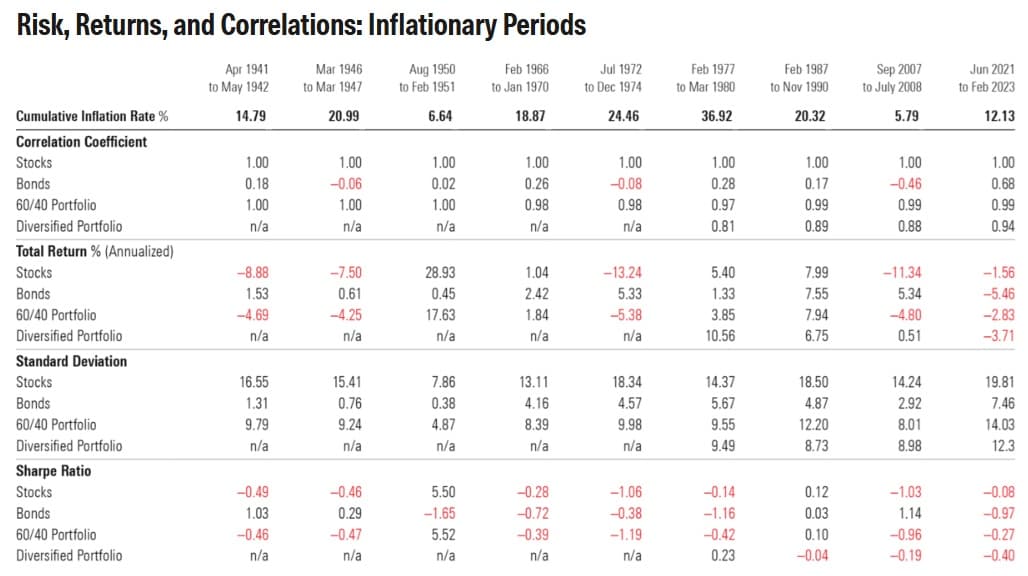
Morningstar reached a similar conclusion using a different dataset. Its research found that stock-bond correlation turned positive in 2021 and remained above 0.5 between 2022 and 2024, largely because of the return of higher inflation.
That may be the biggest challenge facing the traditional 60/40 allocation today.
Bonds were traditionally part of the portfolio because of the fact that they often moved differently from stocks. If that relationship weakens, the portfolio may no longer deliver the same diversification benefits.
Diversification Isn't What It Used to Be
Even if the relationship between stocks and bonds had remained unchanged, there is another major shift you shouldn't ignore. The equity side of the traditional 60/40 portfolio isn't as diversified as it used to be.
Over the past few years, a handful of large tech companies have accounted for a growing share of the S&P 500's gains. According to Torsten Sløk, Chief Economist at Apollo Global Management, the ten largest companies now make up roughly 40% of the index. Much of that concentration has been driven by companies leading the AI boom.
That would matter even if AI exposure were limited only to equities. But increasingly, it isn't.
Sløk points out that AI is also becoming one of the biggest drivers of the corporate bond market. Nearly half of this year's investment-grade bond issuance has been linked to financing AI infrastructure, particularly the massive data centers being built by hyperscalers.
Hyperscalers like Amazon, Alphabet, Meta, Microsoft, and Oracle have displaced banks as top corporate bond issuers. AI-related debt is approaching 15% of total US investment-grade issuance, with Wall Street anticipating up to $300 billion in AI supply for the full year. 87% of venture funding is also now flowing into AI-related companies, far more concentrated than in previous technology cycles.
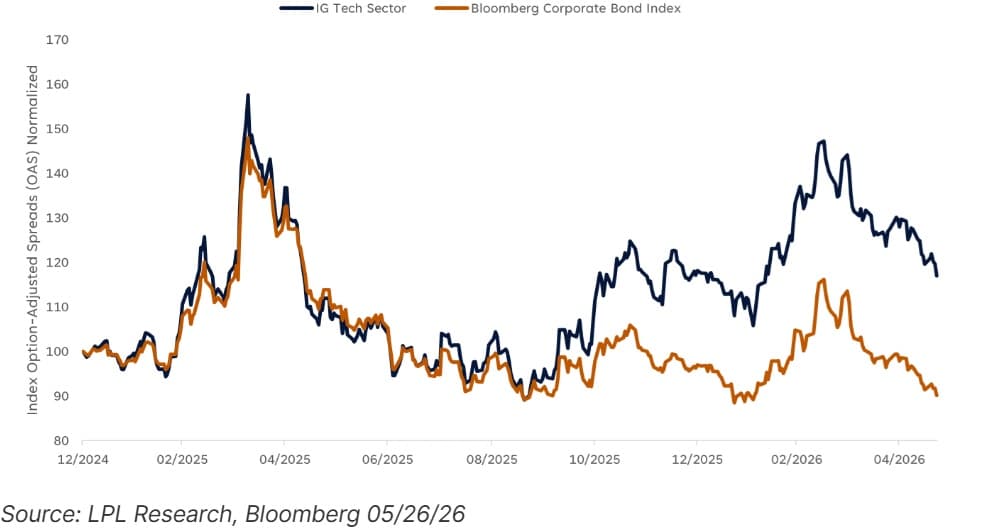
The point is that many investors assume they are spreading their risk simply by owning both stocks and bonds. In reality, parts of both portfolios are increasingly tied to the same economic theme. Diversification across asset classes doesn't necessarily guarantee diversification across underlying risks anymore.
We don't argue that the 60/40 approach deserves to be thrown out now. Mark Twain once warned us against tearing down a fence before understanding why it was put up in the first place. The 60/40 portfolio served a real purpose. It kept people from chasing whatever was hot and from panicking when the market corrected sharply.
The current environment probably lowers the effectiveness of a 60/40 strategy given the change in stock-bond relation, new interest rate-inflation dynamics, geopolitical turmoil, and higher concentration in both debt and equity. However, judicious investors can always find new ways of using time-tested strategies.