
Happy Monday! Finally, the biggest test of the market's strength is here with the tech earnings season kicking off. Four of the report this week: Apple, Meta, Microsoft, and Tesla. And the timing couldn't be more important, especially after two jittery weeks.
Well, we've seen this movie before: the specter of tariffs returns time and again, and the market suddenly gets a bit wary. Unsurprisingly, all three major indexes posted back-to-back weekly losses.
This marked the S&P 500's first two-week losing streak since June.
The Dow fell 0.5% on the week. The S&P 500 lost about 0.4%, while the Nasdaq slipped less than 0.1%, both logging a second straight losing week. Small caps were poised to end a 14-day win streak as investors rotated back into technology.
Still, it's not bearish everywhere. Roughly 60 S&P 500 stocks are sitting at fresh 52-week highs.
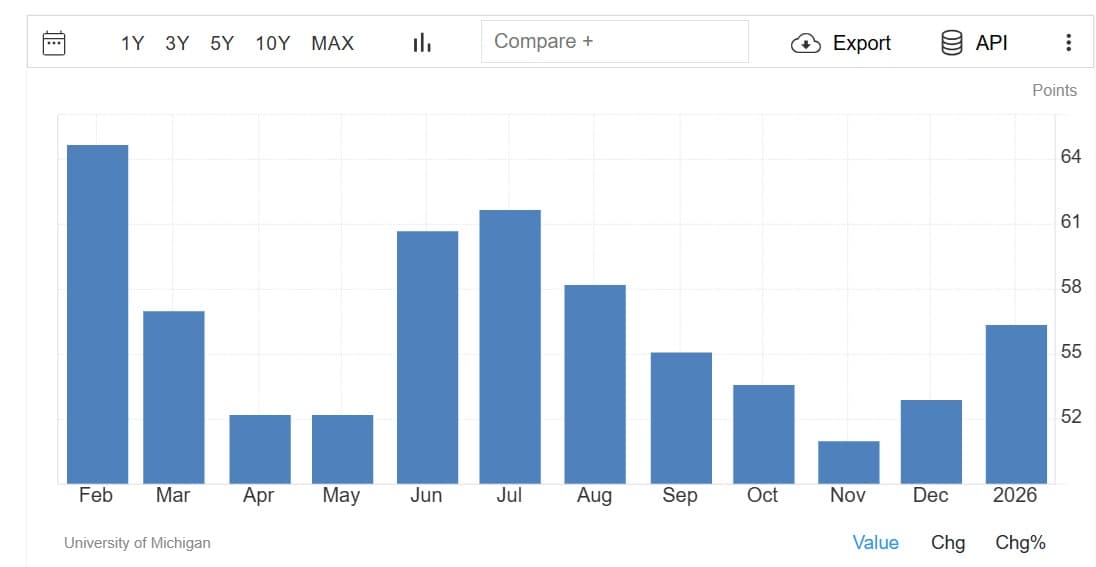
More importantly, US consumer sentiment improved in January. The University of Michigan's final January index rose to 56.4, a five-month high, as Americans grew more optimistic about their finances and the broader economy.
The Deep Dive
This week, we highlight four stories shaping sentiment in February:
- Big earnings week ahead, with four Mag 7 giants reporting
- Intel tumbles 17% in its worst session since 2024 despite an earnings beat
- Gold breaks $5,000 as geopolitics push investors toward safety
- BofA's "hyper-bull" signal: investors go all-in as hedging disappears
Let's take a closer look…
1. Big earnings week ahead, with four Mag 7 giants reporting
The most important week of earnings season is here. Apple, Meta, Microsoft, and Tesla all report Q4 results over the coming days. Investors are closely watching for any shift in the market's leadership narrative.
Looking ahead, analysts expect double-digit earnings growth across the board in 2026. The estimated growth rate for the Magnificent 7 is 22.8%, compared with 12.1% for the other 493 companies in the S&P 500.
Tech remains the biggest engine of earnings momentum. The Information Technology sector is projected to deliver the strongest year-over-year growth of any sector at 26.2%.
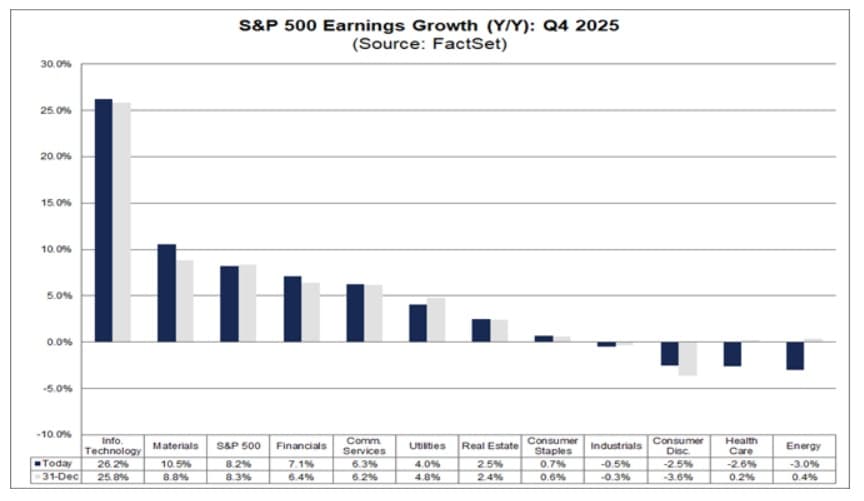
Semiconductors lead the way, with earnings growth near 47%, followed by electronic components, software, and hardware.
At the company level, NVIDIA remains the single largest contributor. Without it, the sector's growth rate would fall sharply, from 26.2% down to 18.5%.
This week's earnings will help answer a familiar question: Is the next leg of the bull market still concentrated in a handful of giants, or is leadership finally starting to broaden out?
2. Intel tumbles 17% in its worst session since 2024 despite an earnings beat
Intel just reminded investors how unforgiving semiconductor markets can be. The stock plunged 17% on Friday, its worst day since August 2024, even after the company posted an earnings beat.
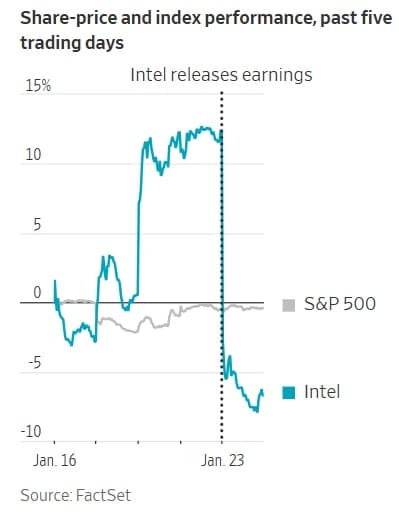
Revenue came in at $13.7 billion, above expectations, and non-GAAP EPS landed at $0.15, nearly double what Wall Street forecast.
But cautious guidance wiped away the optimism almost instantly.
Management warned of supply constraints and weaker production efficiency, and CEO Lip-Bu Tan described the turnaround as a multi-year journey that will take time to play out.
Intel guided Q1 revenue between $11.7 billion and $12.7 billion, below consensus expectations of about $12.5 billion. Adjusted earnings were projected near breakeven, versus forecasts of roughly $0.05 per share.
After a strong rally over the past year on hopes of a comeback fueled by government support and major strategic backing, the market is once again questioning how durable the recovery really is.
3. Gold breaks $5,000 as geopolitics push investors toward safety
While equities have been choppy, gold has been doing what it often does when uncertainty rises.
The metal climbed to a fresh all-time high, crossing $5,000 an ounce on Monday. Spot gold traded around $5,042, extending a record-breaking run as geopolitical tensions and fiscal risks continue to build.
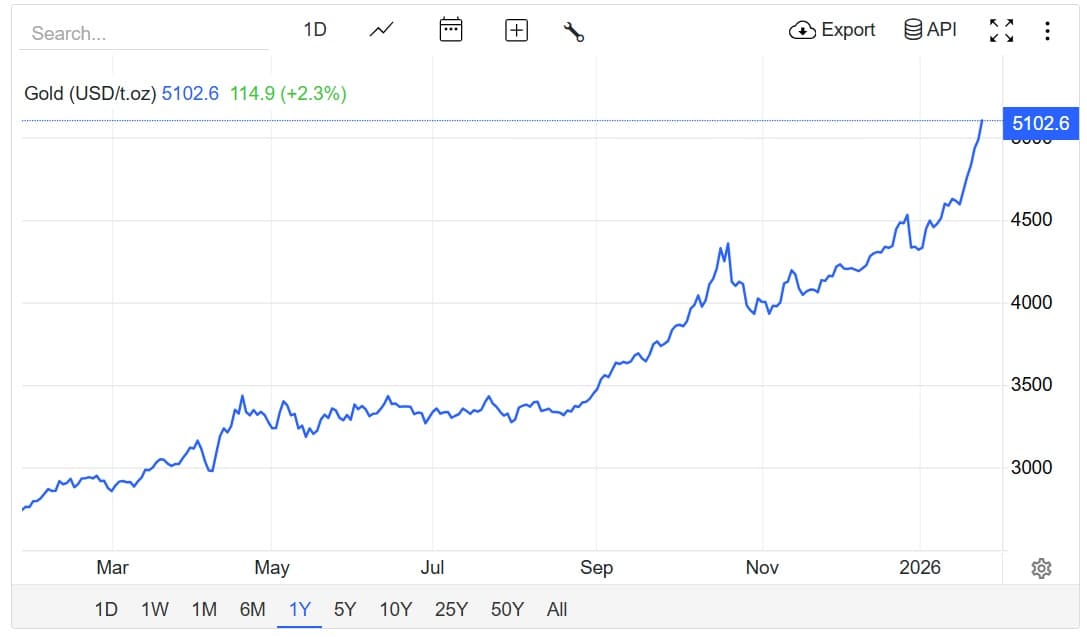
Recent flashpoints from Greenland and Venezuela to the Middle East have pushed investors back toward safety. HSBC noted that geoeconomic concerns have added another leg to the rally.
Silver joined the move as well, jumping 3% to $106 an ounce, supported by both industrial demand and risk hedging.
Union Bancaire Privée expects gold to remain strong, projecting a year-end target of $5,200. Goldman Sachs has gone further, lifting its December 2026 forecast to $5,400.
A key thing to note is how broad the demand has become. Western ETF holdings have climbed by roughly 500 tonnes since early 2025, while high-net-worth families and institutional buyers have increasingly treated gold as a durable hedge against macro-policy risk.
4. BofA's "hyper-bull" signal: Bull & Bear Indicator hits 9.4 as hedging disappears
If you want a clean snapshot of market psychology right now, Bank of America's latest fund manager survey says it all.
Global investors are the most bullish they've been since July 2021. Growth optimism has surged while cash levels have dropped. And, most importantly, hedging has almost disappeared.
BofA's Bull & Bear Indicator jumped to 9.4, firmly in what the bank calls territory. That's an extreme reading, and historically, extremes tend to matter.
Fund managers are now holding record-low cash allocations of just 3.2%, and equity-correction protection is at its lowest level since January 2018. In other words, investors are positioned as if the road ahead is as smooth as it can be.
The survey covered 96 participants managing $575 billion in assets, and the message is clear: risk appetite is back in full force.
Before we sign-off
Markets move not just on data, but on how investors interpret them. In each of the stories we cover, it all comes down to market expectations and sentiment. When sentiment runs ahead of fundamentals, what follows is volatility.
At AlphaPro, we track the voice behind the numbers and tone of earnings calls, policy speeches, and analyst commentary. Our Earnings Sentiment Score helps you cut through the noise and see how executives and policymakers are shaping narratives in real time.
Same time next week? See you then.
Want to explore real-time sentiment scores, earnings call insights, and curated stock research?