The PE ratio is probably the most relied-upon valuation metric in investing. As soon as you open any earnings report or scan any stock screener, the PE is there front and center. It's easily comparable, and it's been around for so long that most investors treat it like a default option.
PE works too, but only up to a point.
PE measures how much investors are paying for a company's reported earnings. The problem, however, is that earnings are an accounting number. So, companies can legally stretch revenue recognition or adjust depreciation. They can also capitalize certain expenses, which means the earnings figures can change without a proportionate change in the underlying business.
But it's more difficult to dress up in cash. That's one reason market gurus like Aswath Damodaran and investing legends like Warren Buffett and Terry Smith have long looked beyond PE. Instead, they keep coming back to another tool: Free Cash Flow (FCF) and specifically, three metrics built around it.
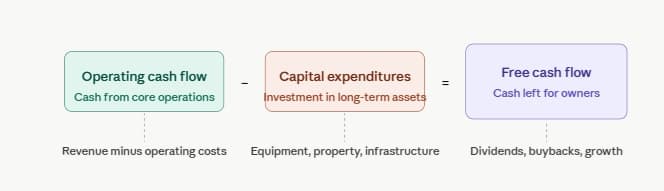
Free cash flow is what a company is left with after paying for its operating expenses and capital expenditures. Peter Lynch called it "what's left over after normal capital spending is taken out." This is what funds dividends, buybacks, acquisitions, and growth.
Here are the three FCF-based metrics worth tracking.
1. FCF Growth: Is the Business Generating More Cash Each Year?
FCF growth shows how a company's free cash flow changes over time.
A company's PE can look attractive when earnings are temporarily inflated. But it's much more difficult to fake FCF growth over multiple years. When a business consistently generates more free cash flow year after year, it's a stronger indication that the underlying business is getting stronger. The converse is true as well: if FCF is flat or declining while earnings look healthy, something is usually not right.
According to Damodaran, who spent decades refining valuation frameworks, free cash flows are the foundation for estimating future ones. This also forms the basis of intrinsic valuation.
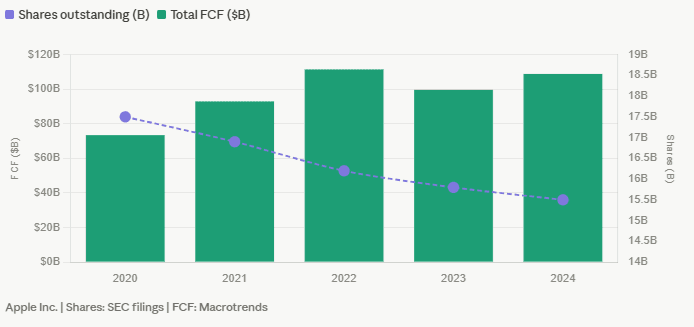
Let's look at the example of Apple. Between 2020 and 2024, its FCF grew from $73.4 billion to $108.8 billion - a 48% increase. Over the same period, the stock nearly doubled from $129.75 to $250.42.
But FCF has its caveats - a strong FCF growth in a single year may be distorted by capex timing or a change in working capital. So, what you want to look at is consistency across at least three to five years. Also, it's worth looking at what's driving the FCF growth. For instance, while FCF growth coming from genuine margin expansion is sustainable, it may not be so if FCF growth comes from cutting capital investment.
2. FCF Per Share: Is Your Slice of the Pie Growing?
A business can grow its total free cash flow, and still the individual shareholders may be worse off. This happens when the company issues new shares faster than its FCF grows. More shares mean each one represents a smaller claim on the same pool of cash. FCF per share helps you detect that.
The metric is simple: divide total free cash flow by shares outstanding. This gives you the cash the business generated for each share. When you track it over time, you can see whether shareholders are getting a bigger or smaller slice year by year.
In his 1986 shareholder letter, Buffett argued that standard accounting metrics like net income often fail to reflect the economic reality of a business. This is because not all earnings are created equal. What he focused on was how much cash was actually flowing back to the owner of each share. FCF per share is probably the closest practical equivalent to that idea.
Apple is again a useful example here. Between 2020 and 2024, the company reduced its diluted share count from roughly 17.5 billion to about 15.5 billion - buying back nearly 2 billion shares using its own free cash flow.
Apple spent approximately $716 billion on buybacks over the past decade. The effect is that even if total FCF had stayed flat, each remaining share would represent a larger claim on those cash flows. Combined with actual FCF growth, the per-share number improved on both ends simultaneously.
This is what Buffett means when he talks about per-share economics.
Companies growing FCF while shrinking their share count are compounding value for shareholders in two ways at once. Conversely, a company growing FCF while issuing shares heavily may be running faster just to stay in place.
3. FCF Yield: What Are You Paying for That Cash?
FCF yield is calculated by dividing a company's free cash flow by its market capitalization. A 5% FCF yield means the business generates five cents in free cash for every dollar of its market value. Imagine this as the cash return you'd earn if you bought the entire company at its current price.
This is the metric Terry Smith, founder of Fundsmith and one of Britain's most closely watched fund managers, uses as his primary valuation yardstick. Smith prefers FCF yield over PE ratios because his preferred companies are less capital-intensive and generate higher returns on capital than the market average.
Smith aims to buy stocks when their FCF yield is at least as high as what you'd expect from long-term government bonds, based on a scenario roughly 1% above expected inflation. In other words, he uses it as a direct comparison against the risk-free alternative.
PE will always have a significant place in every investor's toolkit. It's great for a quick comparison. But it doesn't tell the complete story.
FCF growth, FCF per share, and FCF yield together answer three different questions: is the business generating more real cash, is each shareholder's claim on that cash growing, and is the current price reasonable relative to what the business actually produces. That's a more complete picture.